
What Is Armenian Art? Styles, History & Where to See It
A carved cross-stone in a churchyard and a gilded Gospel page in a museum case look very different, but they belong to the same tradition. This guide connects them. It covers the main forms of Armenian art, how they developed over many centuries, and where you can see them around Los Angeles.
What Is Armenian Art? The Short Answer
Armenian art is the visual art made by Armenians in Armenia and across the diaspora. It includes manuscript illumination, khachkars (carved cross-stones), stone carving on churches, painting from medieval frescoes to modern canvases, and decorative arts such as ceramics, carpets, and textiles.
Below, I go through each form and note which ones show up in Los Angeles, based on what we see in the Armat Platform event listings.
Terms to know
- Khachkar (also spelled khatchkar in Western Armenian transliteration): from khach (cross) and kar (stone). It's a carved stone slab with a cross at its center.
- Scriptorium (plural scriptoria): a workshop, usually in a monastery, where scribes copied and decorated manuscripts.
- Matenadaran: "repository of manuscripts." It's the name of the national manuscript archive in Yerevan.
- Kütahya: a city in western Anatolia known for glazed pottery, including work by Armenian potters.
Armenian Art History in Four Periods
Let's break it down. No period started from scratch. Each one took what came before and carried it forward.
| Period | Rough span | What defines it |
|---|---|---|
| Ancient foundations | Before the 4th century CE | Metalwork, stone, and pre-Christian temple building |
| Medieval golden age | 4th to 14th century | Churches, illuminated Gospels, khachkars |
| Early modern centers | 15th to early 20th century | Ceramics, textiles, diaspora workshops |
| Contemporary and diaspora | 20th century to today | Easel painting, mixed media, global studios |
Ancient foundations
Ancient Armenian art took shape in the Armenian Highlands long before Christianity arrived. Its metalwork, stone carving, and building methods didn't vanish with the old religion. Later church builders picked them up and put them to new use.
Medieval golden age
According to The Metropolitan Museum of Art's 2018 exhibition "Armenia!", Armenia adopted Christianity as its state religion in the early fourth century. The Met's show traced Armenian art from that conversion through the seventeenth century. Church building, manuscript painting, and khachkar carving all grew quickly during these centuries. When most people picture Armenian art, I think this is the era they have in mind, and it's easy to see why.
Early modern centers
As Armenian communities spread out, artists set up workshops in trade cities. Pottery, textiles, and printed books became the main outlets for their work.
Contemporary and diaspora art
Armenian visual arts today cover painting, sculpture, photography, and installation work, and artists make it everywhere from Yerevan to Glendale.
Prefer to watch? This illustrated lecture gives a scholarly overview of the whole story:
Armenian Manuscript Illumination: Gospels, Canon Tables and Scriptoria
Illumination means decorating a handwritten book with painted images, ornamental frames, and gold. Armenian scribes and painters worked mostly on the illustrated Gospel book. Its canon tables are decorated columns that let a reader match up parallel passages across the four Gospels, and they rank among the most striking pages in Armenian art.
The Matenadaran in Yerevan
The Matenadaran, formally the Mesrop Mashtots Institute of Ancient Manuscripts, takes its name from the scholar credited with creating the Armenian alphabet in the early fifth century. It holds more than 20,000 manuscripts, which makes it one of the world's largest collections of medieval manuscripts. If you ever visit Yerevan, I'd put it at the top of your list.
Cilician Armenia's scriptoria
From the late eleventh to the fourteenth century, an Armenian kingdom held land on the Mediterranean coast in Cilicia. Painters in its monastery scriptoria produced Gospels full of fine detail and rich color, shaped by contact with Byzantine and Crusader art. The Met's exhibition gave these books a central place.
The Khachkar and Stone Carving in Armenian Architecture
What a khachkar is
A khachkar is an upright carved stone with a cross at its center. The cross usually rests on a rosette or "sun disc," and lace-like ornament fills the space around it.
UNESCO inscription
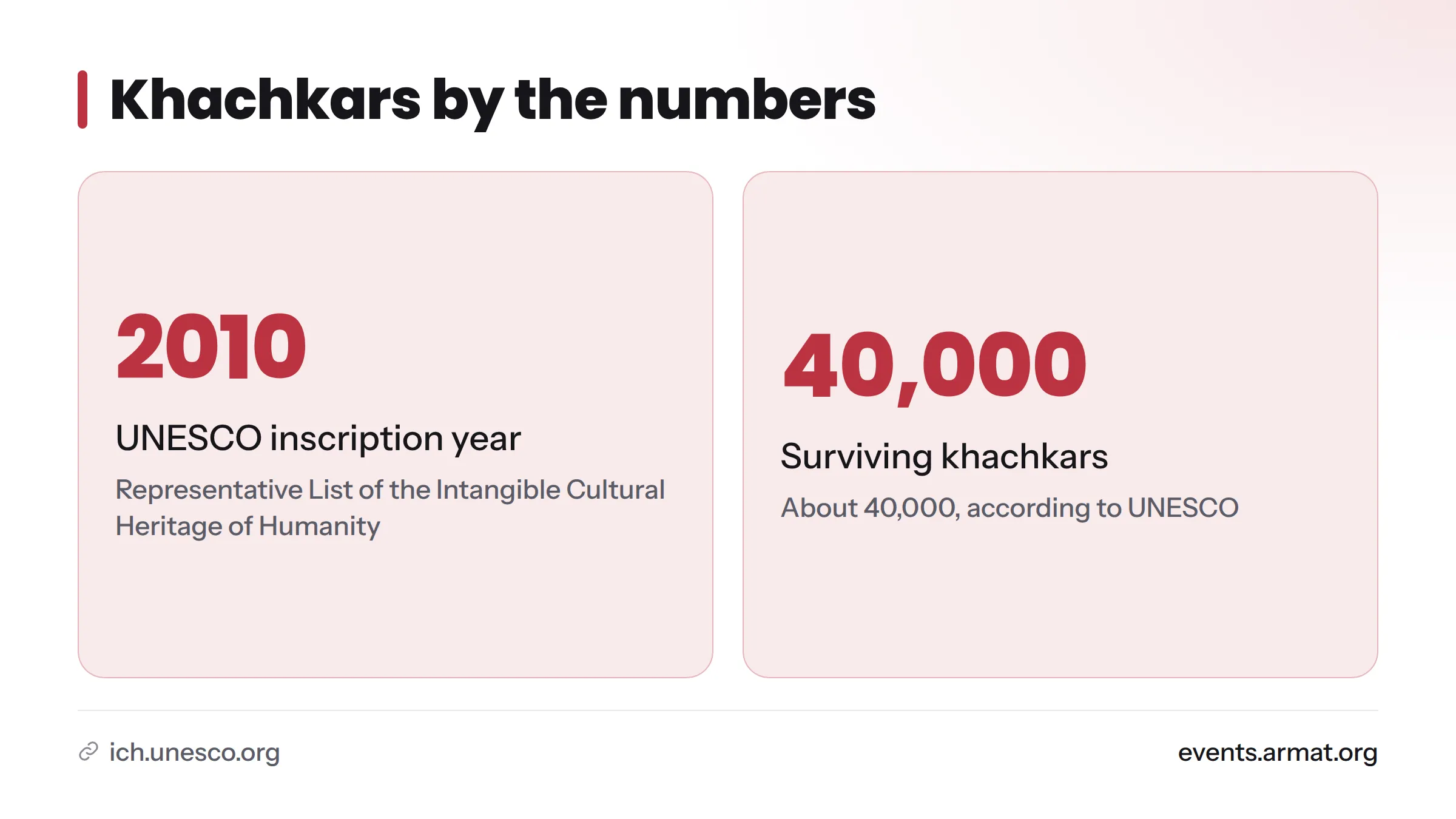
In 2010, UNESCO added Armenian cross-stones art to its Representative List of the Intangible Cultural Heritage of Humanity. UNESCO notes that about 40,000 khachkars survive.
The list entry covers more than the old stones. It recognizes carving as a skill that people still practice and pass on today, so the tradition counts as living heritage, not just a set of monuments.
Church relief carving
Armenian builders also cut reliefs straight into church facades: figures, animals, vines, and geometric bands. Here's my opinion. Stone is the medium Armenian art speaks through most clearly.
Painting: From Frescoes to the Easel
Yes, Armenian churches had frescoes. Painted plaster once covered many church interiors, though weather and time have destroyed much of it. Over the centuries, painting moved off church walls and book pages onto portable canvases. By the nineteenth and twentieth centuries, easel painting had become a major Armenian form.
Looking for names and masterpieces? Our upcoming guides to famous Armenian artists and famous Armenian paintings will cover them.
Ceramics and Textiles: Glazed Tiles, Embroidery and Carpets
Kütahya ceramics
Armenian potters in Kütahya made glazed cups, tiles, and devotional pieces. Many carry painted inscriptions in Armenian script, which makes them easy to pick out.
Armenian ceramics of Jerusalem
After the First World War, potters from Kütahya carried the tradition to Jerusalem. Their family workshops still turn out the blue, turquoise, and floral pieces that visitors see in the Old City.
Armenian carpets and textiles
Weavers and embroiderers marked regional identity through pattern, color, and costume details. Our upcoming guide to traditional Armenian decorative arts will go deeper into technique.
Armenian art styles at a glance
| Form | Main material | Traditional setting | Where you might see it today |
|---|---|---|---|
| Manuscript illumination | Parchment, pigment, gold | Monastery scriptoria | Museum collections, Matenadaran |
| Khachkars | Stone | Churchyards, monasteries | Armenia, church grounds abroad |
| Relief carving | Stone | Church facades | Medieval churches in Armenia |
| Painting | Plaster, canvas | Churches, studios | Galleries and exhibitions |
| Ceramics | Glazed clay | Homes, churches | Jerusalem workshops, collections |
| Carpets and textiles | Wool, silk, thread | Homes, festive dress | Heritage events, collections |
Where to See Armenian Art in Los Angeles
Now for the local part. In Armat's listings, contemporary painting and gallery exhibitions come up most often, with textile and costume programs close behind. Two recent examples are a textile-inspired art exhibition and a talk on traditional Armenian costumes. Dates and venues change, so check each listing for current details.
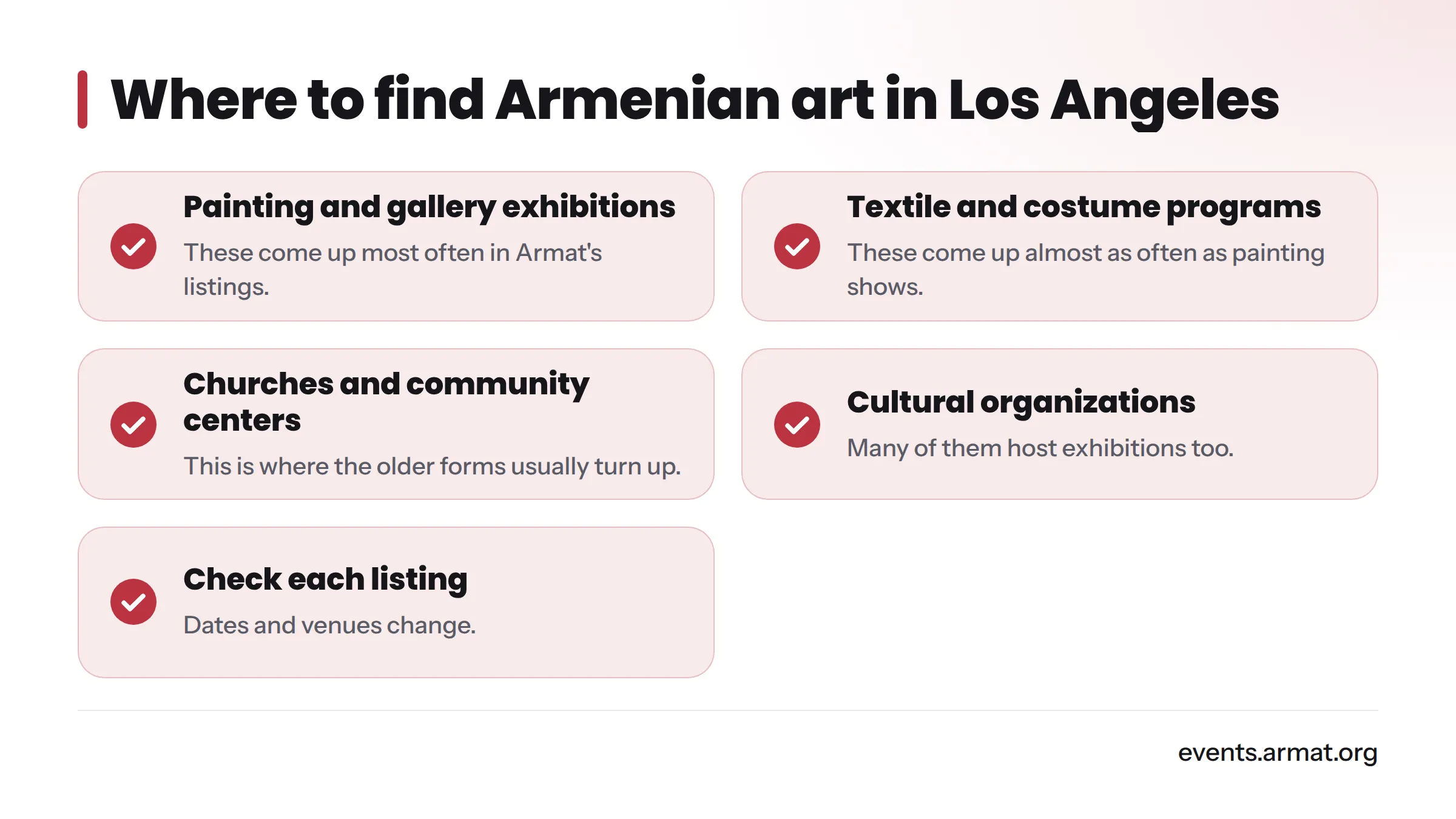
The older forms usually turn up at churches and community centers. Our guide to Armenian heritage in Los Angeles neighborhoods covers Glendale, Burbank, Pasadena, and Hollywood. Many Armenian cultural organizations in Los Angeles host exhibitions as well.
Armenian diaspora art in LA: Local artists often reinterpret the old forms. Khachkar lattice becomes abstract pattern, manuscript colors show up in digital prints, and embroidery motifs move onto canvas.
Where to Go Next: Artists, Paintings and Exhibitions
Pick your next stop based on what caught your eye:
- Curious about the people? Read our guide to famous Armenian artists.
- Want to see specific works? Read famous Armenian paintings.
- Drawn to handwork? Read traditional Armenian decorative arts.
- Ready to see it in person? Browse Armenian events in Los Angeles.
- Interested in the wider culture? Read our guide to Armenian cultural events in Los Angeles.
Next steps: Find current Armenian art exhibitions in Los Angeles on the Armat calendar and choose one to see this month.
Written by Armat's arts and culture editor.