
Must-Visit Armenian Festivals and Celebrations in LA
Ask an Armenian grandmother in Glendale which month is quiet, and she'll probably laugh. Los Angeles County has one of the largest Armenian communities outside Armenia. Its calendar runs from ancient church feasts to summer water fights to park festivals that pull in whole neighborhoods.
The hard part is finding them. Details sit in church bulletins, Facebook groups, and Instagram stories that often leave out the year. We put this guide together to fix that. It covers the Armenian festivals in Los Angeles worth your time, what each one means, and how to confirm this year's dates.
The must-visit Armenian festivals and celebrations in LA:
- Armenian Independence Day festivals (September)
- Vardavar, the summer water festival (June or July)
- Armenian Christmas, Surb Tsnund (January 6)
- Church food fairs and picnics (spring through fall)
- Blessing of the grapes (mid-August)
- Trndez bonfire celebration (mid-February)
- Armenian film festivals (late summer and fall)
- Music and arts days at UCLA
- Armenian food festivals in Glendale
- April heritage and remembrance events
Dates change every year. Feast days move with Easter, and organizers pick new weekends each season. Check the Armenian festival listings on Armat for confirmed dates, venues, and tickets before you go.
Armenian Holidays Calendar for LA: The Whole Year in One Table
Let's break it down. "Typical month" shows how the community usually schedules each event. It isn't a promise for 2026.
| Celebration | Typical month | What it is | Typical setting | Best for | Cost type |
|---|---|---|---|---|---|
| New Year (Amanor / Nor Tari) | Dec 31 to early Jan | Family tables and community parties | Homes, banquet halls | Families, friends | Mostly ticketed for parties |
| Armenian Christmas (Surb Tsnund) | January 6 | Nativity and Theophany together | Churches | Faith-focused visitors | Free services |
| Trndez | Mid-February | Bonfire feast of the Presentation | Church grounds | Newlyweds, families | Usually free |
| Vartanants | February or March | Remembrance of the Battle of Avarayr | Churches, schools | Students, history fans | Free |
| Zatik (Easter) | March or April | Resurrection feast, egg tapping | Churches, homes | Families | Free services |
| April heritage and remembrance | April | Heritage programs and April 24 commemoration | Civic sites, monuments | Everyone | Free |
| Church food fairs (kermes) | Spring to fall | Food, music, raffles | Church grounds | Foodies, first-timers | Free entry, pay per plate |
| Vardavar | June or July | Water-splashing festival | Churches, parks | Kids, teens | Usually free |
| Blessing of the grapes | Sunday near August 15 | Grapes blessed at the Assumption feast | Churches, picnics | Faith-focused, families | Free, donation |
| Independence Day festivals | September | Celebrating September 21, 1991 | Parks, regional venues | First-timers, everyone | Often free or low-cost |
| Armenian film festivals | September to fall | Cinema from Armenia and the diaspora | Theaters | Film lovers | Ticketed |
| Holy Translators' Day | October | Honoring the Armenian alphabet | Schools, churches, book fairs | Readers, students | Free |
| Food festivals | Fall | Food, wine, live music | Glendale venues | Foodies | Ticketed or pay per plate |
Winter: Church Feasts, Bonfires, and Packed New Year Tables (December to February)
Winter revolves around the church more than any other season. It's also when many families feel the strongest pull back toward tradition.
Armenian Christmas in Los Angeles: Why It Falls on January 6
The Armenian Apostolic Church keeps an ancient Christian practice: it celebrates the Nativity and the Theophany (the baptism of Jesus) on the same day, January 6. Most of the early church once did the same. Armenians just never split the two feasts apart.
You may also hear about January 19. The Armenian Patriarchate of Jerusalem follows the older Julian calendar, so its January 6 lands on January 19 in the Gregorian calendar.
Around LA, Christmas Eve and Christmas morning services fill churches from Burbank to Pasadena. Many parishes hold the blessing of water after the Divine Liturgy. Then everyone heads home to eat. Want to cook along? Our guide to traditional Armenian Christmas dishes walks you through the table. For service times, the Western Diocese of the Armenian Church and the Western Prelacy both post schedules for their parishes.
New Year (Amanor or Nor Tari): The Holiday That Rivals Christmas
In plenty of Armenian homes, New Year carries as much weight as Christmas. Tables fill up with dried fruit, nuts, gata (a sweet layered bread), and dishes that took two days to make. Banquet halls across Glendale and the Valley host ticketed parties with live bands.
Here is why the table matters so much: each dish carries a wish for the year ahead. Read about the traditions behind the Armenian New Year table. If you'll be raising a glass, study the complete guide to Armenian toasts first. A kenats (toast) at an Armenian table is a short speech, not a quick "cheers." Community organizers such as genatz.la post social gatherings on Armat throughout the season.
Trndez: The February Bonfire
Trndez (also spelled Tyarndarach or Diarnuntarach in Western Armenian) is the Feast of the Presentation of the Lord to the Temple, 40 days after January 6. The church celebrates it on February 14 and lights the bonfire on the evening of February 13.
After evening services, parishioners build a fire in the churchyard. Newlywed couples jump over it together for a blessing, and people carry home embers or ash for luck. Kids love it. Parents watch the jumping closely.
Vartanants: The Feast of St. Vartan
Vartanants honors Vartan Mamikonian and the soldiers who died defending their Christian faith at the Battle of Avarayr in 451 AD. The church marks it on the Thursday before Great Lent. Armenian day schools in LA often put on plays, recitations, and assemblies around the feast, so check school calendars too.
Barekendan: One Last Party Before Lent
Barekendan roughly means "good living." It's the final round of feasting, costume parties, and dancing before Lent starts. Church halls and community centers host dinners and kids' parties. I'd call it one of the most playful dates on the calendar, and a gentle first visit if you're new.
Spring: Easter, Remembrance, and the First Church Fairs (March to May)
Spring brings Easter, the most solemn month of the year, and the opening of fair season.
Zatik: Armenian Easter
Zatik is the Feast of the Resurrection. Families dye eggs red with onion skins and play havgitkhagh, or egg tapping. Two players knock the tips of their eggs together, and whoever's egg survives wins. In my experience, every family has one uncle who swears by a secret method for picking the strongest egg. Churches hold services the night before and on Easter morning.
April 24 Commemoration in Los Angeles and Armenian History Month
April carries two meanings for Armenians in LA. The City of Glendale has marked April as Armenian History Month in recent years, with exhibits, talks, and school programs, so April brings some of the busiest Armenian celebrations Glendale hosts all year. Check the City of Glendale website for this year's events.
April 24 is Armenian Genocide Remembrance Day. It marks the 1915 arrests of Armenian intellectuals and community leaders in Constantinople, which began the genocide in which an estimated 1.5 million Armenians died. In LA, thousands gather in Little Armenia in Hollywood, at the Armenian Martyrs Monument in Montebello's Bicknell Park, and in Glendale.
This is not a festival. April 24 events are memorials. Wear subdued clothing, follow the organizers' lead, keep photos discreet during prayers and moments of silence, and come to listen. Non-Armenians are welcome and appreciated.
March 8 and Motherhood and Beauty Month
International Women's Day on March 8 is a big deal in Armenian households, with flowers, dinners, and gifts. Armenia also marks April 7 as Motherhood and Beauty Day, and some people call the weeks in between Motherhood and Beauty Month. Look for community luncheons and boutique pop-ups. Our March 8th shopping guide to Armenian women-owned brands is a good place to start.
Armenian Church Festivals in LA Open for the Season
Once the weather warms up, parishes open their grounds for food fairs. Western Armenians often call these a kermes, a word borrowed from the Turkish term for a church bazaar or fair. You'll usually find a grill line, a pastry table run by the church women's guild, a raffle, and a band. The Holy Cross Armenian Food Fair & Fest shows the format at its best.
Summer: Water Fights, Grapes, and Khorovats Smoke (June to August)
Summer moves everything outdoors. Honestly, it's when the community sounds loudest and happiest.
Vardavar in Los Angeles: Armenia's Water Festival
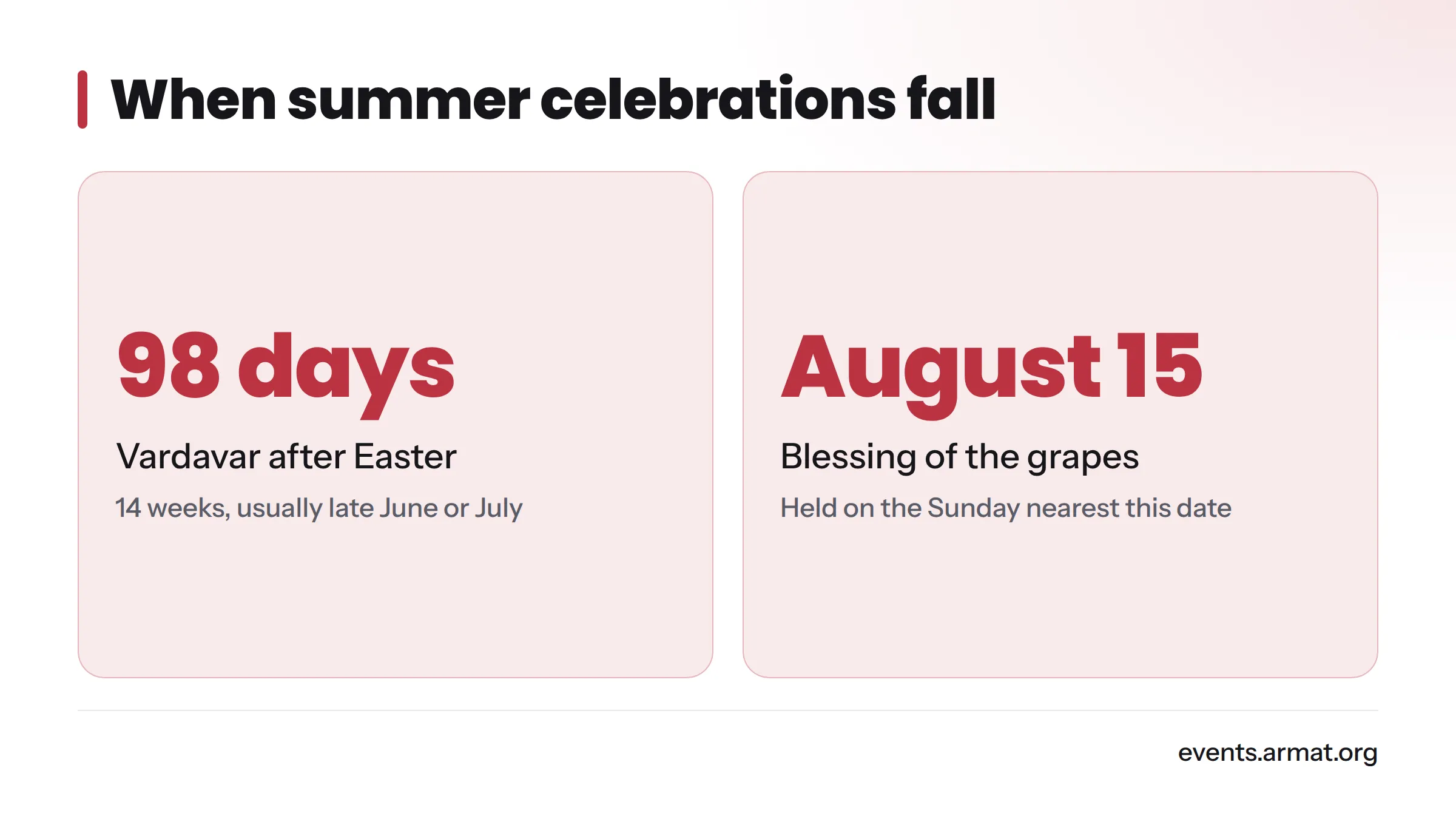
Vardavar is a summer festival where people drench each other with water. It falls alongside the Feast of the Transfiguration of Christ, and its roots reach back to pre-Christian Armenia and the goddess Astghik. The church sets it 98 days (14 weeks) after Easter, so the date shifts every year and usually lands in late June or July.
The rules are simple. Anyone outdoors is fair game, and buckets, water guns, and hoses all count. Local celebrations tend to happen on church grounds and in parks, often after a morning service. The Vardavar entry on Wikipedia covers the holiday's ancient origins in more depth.
My honest tip: put the kids in swimwear under their clothes, and bring a towel and a full change of clothes for yourself. Your phone goes in a zip bag.
Blessing of the Grapes
The blessing of the grapes takes place on the Feast of the Assumption of the Holy Mother of God, held on the Sunday nearest August 15. The Armenian name for the Holy Mother of God is Astvatsatsin (Eastern) or Asdvadzadzin (Western).
Tradition says to hold off on eating the new grape harvest until this feast, offering the first fruits back to God. After the Divine Liturgy, the priest blesses baskets of grapes and shares them with everyone present. Many parishes follow up with a picnic and madagh, a blessed meal often made with lamb or chicken and given freely. Some communities serve harissa, a slow-cooked wheat and meat porridge. Read about harissa and the story behind it.
Church Picnics and Summer Festivals
Summer picnics follow a familiar rhythm. The khorovats (Armenian barbecue) is smoking by noon, the band sets up by early afternoon, and the dance circle holds together until sunset. Entry is usually free, and you pay per plate.
Youth Camps and Cultural Programs
Armenian scouts, dance ensembles, and youth groups run camps and performances all summer. A new generation leads much of this work, and our feature on how young Armenians in LA are reviving cultural traditions tells their story.
Fall: Park Festivals, Film, and Food (September to November)
Fall brings the largest crowds of the year, from park festivals to film screenings to food events.
Armenian Independence Day Festivals (September 21)
Armenian Independence Day falls on September 21. It marks the 1991 referendum in which Armenian voters chose independence from the Soviet Union.
Community festivals across LA celebrate with music, dance performances, food booths, and vendors. Past editions of the Armenian Independence Day festival in Glendale have taken place at Verdugo Park. In Orange County, a large regional Independence Day festival has filled Irvine's Great Park with food, live entertainment, cultural exhibits, shopping, and hands-on activities.
Organizers usually pick a weekend near the 21st, since the date itself often lands on a weekday. In 2026 it fell on a Monday. Confirm each year's location on the listing before you head out.
Armenian Film Festival in Los Angeles
The Armenian Film Society runs a multi-day Armenian Film Festival in Los Angeles that screens work from Armenia and the diaspora. Its 2026 edition was scheduled for September 3 to 7, according to its event listing. Standalone screenings, such as "A Taste of Golden Apricot," pop up throughout the year.
Up for a weekend away? The Golden Gate Armenian Film Festival in the Bay Area is worth the trip.
Armenian Food Festival in Los Angeles: Glendale Leads the Way
Food sits at the center of most Armenian gatherings, so dedicated food festivals were bound to show up. An Armenian Food Festival in Glendale, which organizers billed as the first of its kind in LA, was scheduled for November 1, 2026, with food, Armenian wines, and live music. If it turns into an annual event, watch the listings for next year's date. For everyday eating, use our list of the best Armenian restaurants in LA.
Holy Translators' Day (Targmanchats)
Every October, the church honors the Holy Translators. Mesrop Mashtots led the group and created the Armenian alphabet around 405 AD, and Sahak Partev worked with him to translate the Bible. Armenian schools mark Targmanchats with reading events and student performances. The Armenian Book Fair fits right into the season.
Music, Arts, and Campus Festivals
UCLA hosts an annual Day of Armenian Music, Arts, and Culture, which has reached its fifth edition. Student groups keep the campus calendar full, led by the UCLA Armenian Students' Association. Events like Armenian Cultural Night and programs from organizers such as Armenian Arts bring music and dance to a younger crowd. Our guide to Armenian student organizations in LA lists more groups.
Where Armenian Events in LA Happen: A Neighborhood Guide
Armenian life in LA spreads across several hubs, each with its own feel. Our longer guide to Armenian heritage in Los Angeles covers the history of each neighborhood.
Glendale and Burbank
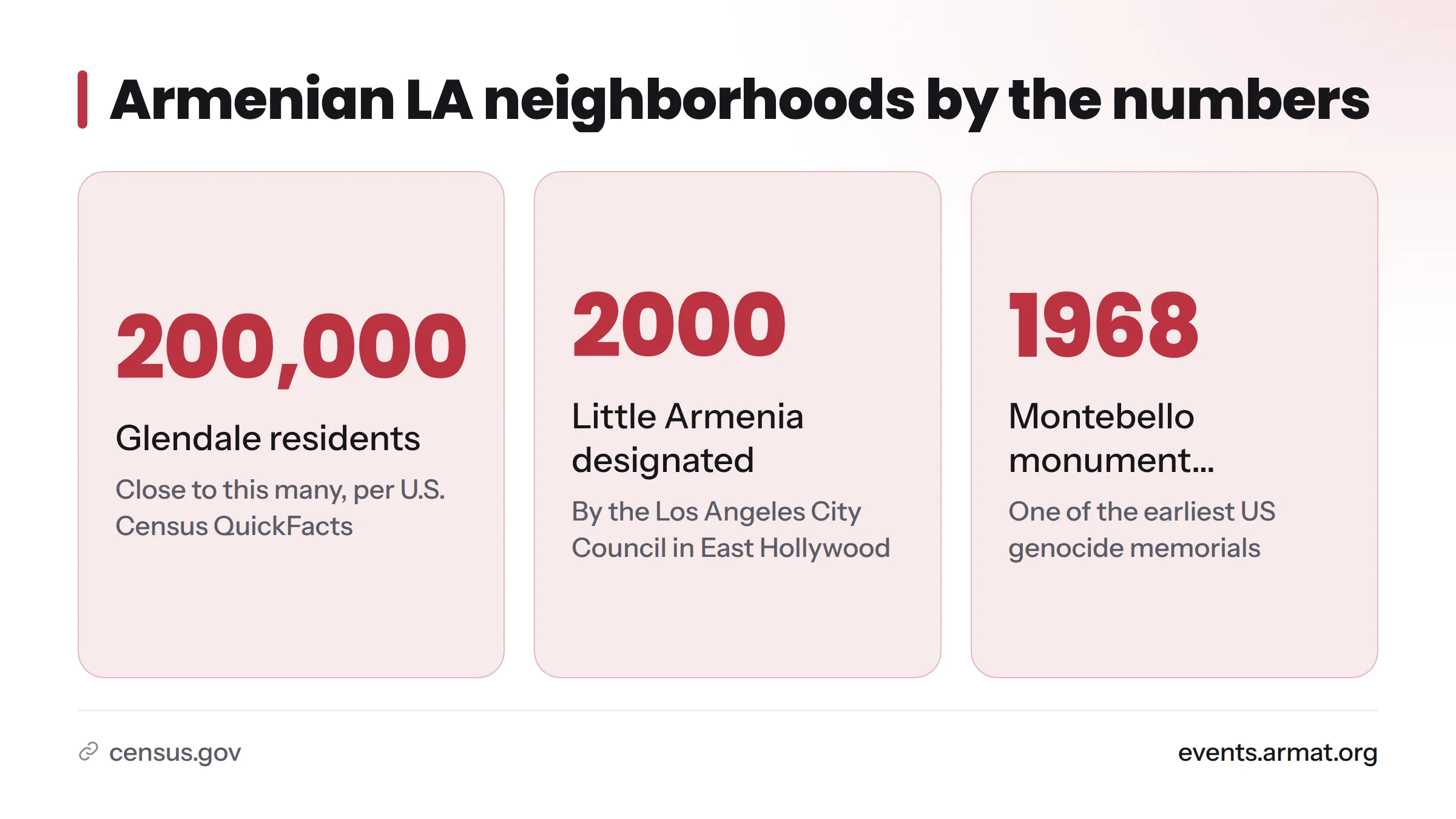
Glendale, a city of close to 200,000 residents according to the U.S. Census Bureau's QuickFacts, sits at the heart of Armenian LA. It hosts park festivals at spots like Verdugo Park, church celebrations, and the newer food festival. Burbank shares many of the same churches, schools, and bakeries.
Hollywood and Little Armenia
The Los Angeles City Council designated Little Armenia in East Hollywood in 2000. The neighborhood anchors the April 24 commemorations and holds older churches, bakeries, and markets.
Pasadena and Montebello
Pasadena has its own Armenian festival tradition and several active parishes. Montebello is home to the Armenian Martyrs Monument, dedicated in 1968 and one of the earliest public genocide memorials in the United States.
CBS LA previewed the Pasadena Armenian Festival in this short segment:
The San Fernando Valley
Granada Hills, North Hollywood, and nearby areas have parishes, schools, and summer picnics of their own. Valley events tend to feel smaller and more family-run.
Worth the Trip: Armenian Festivals in Orange County
Irvine's Great Park has hosted a large Independence Day festival, and Laguna Hills holds its own Armenian festival. Both pull LA families down the 5 freeway and round out the Armenian cultural events in Southern California beyond LA County.
What You'll Eat, Hear, and Find at an Armenian Festival
The Food
- Khorovats: Grilled skewers of pork, lamb, or chicken. The line forms early.
- Lahmajoun: Thin flatbread topped with spiced minced meat. Roll it up with parsley and lemon.
- Manti: Tiny baked dumplings served with yogurt and garlic.
- Lavash: Soft, thin flatbread. UNESCO added Armenian lavash to its intangible heritage list in 2014.
- Gata: A sweet bread or pastry, sometimes with a buttery filling.
- Harissa: Wheat and meat cooked for hours until smooth.
- Sujuk and basturma: Spiced dried sausage and cured beef, often sold by vendors.
Music and Dance
Listen for the duduk, a wind instrument carved from apricot wood with a haunting tone. UNESCO lists the duduk and its music as intangible cultural heritage. The zurna (a loud, bright reed horn) and the dhol (a two-sided drum) power the dance music.
You'll see two dances most often. Kochari is a stomping line dance with linked arms, and shourch par (also spelled shurjpar) is a circle dance. Spellings differ between Eastern and Western Armenian, so don't worry if two signs disagree.
Vendors, Handmade Goods, and Kids' Activities
Look for jewelry, books, ceramics, and Armenian-made products, plus face painting and bounce houses at the bigger events. Many vendors run small family shops. Festival days give you an easy way to back the Armenian-owned businesses in LA you keep hearing about.
Church Festival vs. Park Festival vs. Ticketed Event
| Feature | Church festival or kermes | Park festival | Ticketed cultural event |
|---|---|---|---|
| Entry | Usually free | Often free | Ticket required |
| Food | Homemade, pay per plate | Food booths and trucks | Varies, sometimes none |
| Vibe | Family, intergenerational | Big, loud, crowded | Seated, curated |
| Dress | Modest near the sanctuary | Casual | Smart casual |
| Best for | First-timers, foodies | Families, groups | Film, music, arts lovers |
First Time? Etiquette for Non-Armenians and Newcomers
Everyone is welcome. You don't need Armenian roots, the language, or church membership to attend. Organizers love seeing new faces.
A few pointers make a first visit easier:
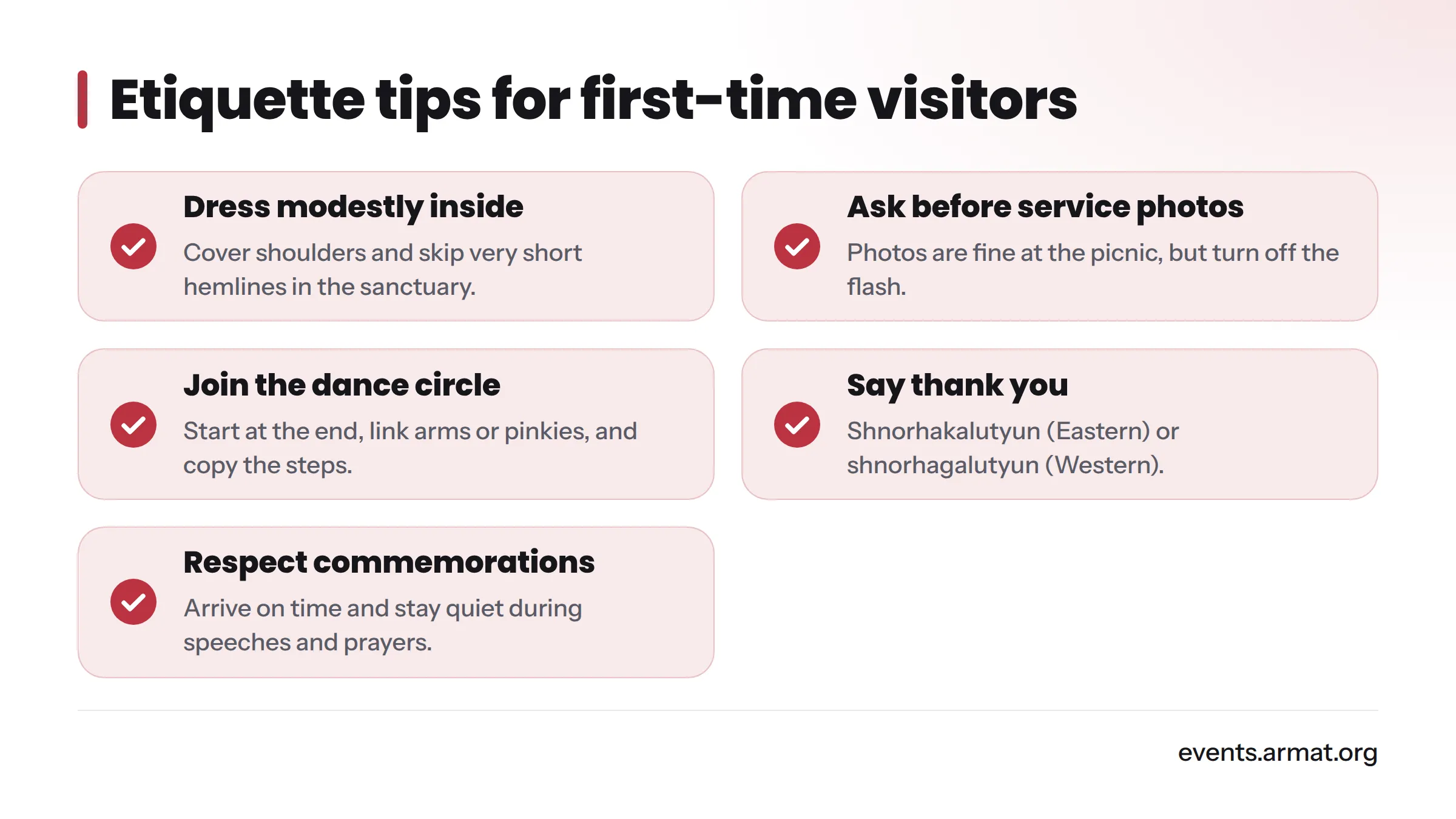
- Dress: Casual clothes work outdoors. If you step into the sanctuary, cover your shoulders and skip very short hemlines.
- Photos: Snap away at the picnic. During services, ask first and turn off the flash.
- Dancing: Join at the end of the circle, link pinkies or arms with your neighbors, and copy their feet. Nobody expects perfection.
- Saying thanks: Shnorhakalutyun (Eastern) or shnorhagalutyun (Western) means "thank you." Merci also works in many LA Armenian homes.
Attending a Commemoration With Respect
Arrive on time, stay quiet during speeches and prayers, and follow the marshals' directions at marches. Bringing flowers to the Montebello monument is a welcome gesture. Please don't treat the event as a photo backdrop.
Which Armenian Festival Fits You?
Next steps depend on who you are:
- Families with young kids: Vardavar and summer church picnics.
- Foodies: Church food fairs and the Glendale food festival.
- Film and arts lovers: The Armenian Film Festival and UCLA's music and arts day.
- Faith-focused visitors: Christmas on January 6, Trndez, and the blessing of the grapes.
- Students and young professionals: Campus nights and networking events.
- Total first-timers: An Independence Day festival. In my view, nothing else gives you the same mix of food, music, and people in one afternoon.
Festival-Day Checklist
- Confirm the date, year, and venue on the listing
- Check whether you need a ticket or RSVP
- Bring cash, since many church booths don't take cards
- Plan parking or transit, and arrive early
- Pack sunscreen, hats, and water for outdoor summer events
- Bring a change of clothes for Vardavar
- Get in the food line before noon
- Follow the organizer for day-of updates
How to Spot an Outdated Post and Find This Year's Dates
Social posts often say "Sunday, September 21" with no year, and they keep circulating long after the event ends. Here's a quick way to check:
- Look up the event's listing on Armat Platform for the current year's date and venue.
- Visit the organizer's own website or page.
- For church events, check the parish bulletin or diocese calendar.
- Match the weekday to the date. If "Sunday, September 21" doesn't fall on a Sunday this year, the post is old.
| Source | Shows the year | Updated by | Best use |
|---|---|---|---|
| Armat Platform | Yes, on every listing | Organizers and Armat | Year-round discovery across LA |
| Organizer websites | Usually | Organizers | Ticket details |
| Church bulletins | Yes | Parishes | Feast days and services |
| Facebook groups | Often not | Members | Community chatter |
I'll be blunt: one directory built for Armenian events beats scrolling through five apps. See our 2026 guide to Armenian cultural events in Los Angeles and our tips on finding Armenian community events near you in LA.
For Organizers: Get Your Armenian Festival Listed
Running a church fair, picnic, or concert? List it on Armat so families find it with the right date attached. Then read how to get the word out about your Armenian event in LA and how organizers can reach more people. Looking for partners? The directory of Armenian cultural organizations in LA is a good starting point.
Glossary of Armenian Celebration Terms
| Term | Meaning | Spelling notes |
|---|---|---|
| Kermes | Church fair or bazaar | Used mostly by Western Armenians |
| Madagh | Blessed meal shared after a service | Matagh in Eastern Armenian |
| Surb Tsnund | Holy Nativity, Christmas | Sourp Dznount in Western |
| Zatik | Easter | Zadig in Western |
| Trndez | Feast of the Presentation | Diarnuntarach, Tyarndarach |
| Astvatsatsin | Holy Mother of God | Asdvadzadzin in Western |
| Khorovats | Armenian barbecue | Khorovadz in Western |
| Amanor | New Year | Also Nor Tari |
Frequently Asked Questions About Armenian Festivals in LA
1. What is the biggest Armenian festival in Los Angeles? Independence Day festivals in September draw the largest festival crowds, including the regional event at Irvine's Great Park. April 24 commemorations gather even more people, but they are memorials, not festivals.
2. When is Armenian Independence Day celebrated in LA? The holiday falls on September 21. LA festivals usually land on a weekend near that date, so check the listings each year.
3. Why do Armenians celebrate Christmas on January 6? The Armenian Apostolic Church keeps the early Christian custom of celebrating the Nativity and Theophany together on January 6. The Jerusalem Patriarchate follows the Julian calendar, so it marks the day on January 19.
4. What is Vardavar and when is it celebrated? Vardavar is a summer water-splashing festival tied to the Feast of the Transfiguration. It falls 98 days after Easter, usually in late June or July.
5. Are Armenian festivals open to non-Armenians? Yes. Everyone is welcome, and most organizers actively hope to see new faces.
6. Are Armenian festivals in LA free? Many church and park festivals have free entry, and you pay for food. Film screenings, concerts, and New Year parties usually require tickets.
7. Where are most Armenian festivals in LA held? Glendale, Burbank, Hollywood, Pasadena, Montebello, and the San Fernando Valley, plus Orange County.
8. What food is served at Armenian festivals? Khorovats, lahmajoun, manti, lavash, gata, harissa, sujuk, and basturma show up most often.
9. What happens at the blessing of the grapes? On the Sunday nearest August 15, a priest blesses grapes after the liturgy and shares them with the congregation. A picnic often follows.
10. How should I attend an April 24 commemoration respectfully? Dress soberly, stay quiet during prayers, follow the organizers, and limit photos.
11. Are there Armenian film festivals in Los Angeles? Yes. The Armenian Film Society hosts a multi-day festival, scheduled for September 3 to 7 in 2026.
12. How can I find Armenian events happening this weekend? Browse Armat's listings and read our guide on how to find Armenian community events near you.
Pick One Celebration and Put It on Your Calendar
The year runs from bonfires in February to splash fights in July, with something in nearly every month. Choose one celebration from this guide and block off the date. Then browse the latest Armenian festival listings, save the events that fit you, and bring a friend who has never been. That's how the circle keeps growing.
Sources
- Armenian Film Festival, Los Angeles (event listing), SupportArmenian
- QuickFacts: Glendale city, California, U.S. Census Bureau
- Lavash, the preparation, meaning and appearance of traditional bread as an expression of culture in Armenia, UNESCO
- Duduk and its music, UNESCO
- Western Diocese of the Armenian Church of North America
- Western Prelacy of the Armenian Apostolic Church
- City of Glendale, California
- Vardavar, Wikipedia