
How Armenian Event Organizers in LA Can Reach More People
You booked the hall, lined up the dancers, and printed the flyers. Then the night arrives, and the room fills with the same faces you saw last year. Familiar faces are a gift. Still, if you run a church festival in Pasadena, a student cultural night in Westwood, or a film screening in Glendale, you know a much bigger Armenian Los Angeles is out there, and most of it never heard about your event.
This guide covers how to reach that bigger community: across generations, dialects, and neighborhoods, plus the non-Armenian neighbors who would gladly come if someone asked. For broader growth tactics, see our companion piece with more audience-growth ideas for Armenian event organizers. This one stays local.
The short answer
Armenian event organizers in LA can reach more people by listing events on community platforms like Armat Platform, promoting in both Armenian and English, partnering with churches, schools, and student associations, scheduling around the community calendar, and following up with attendees to build a contact list.
- List the event on Armat Platform and on pages Google can find.
- Name the audiences you are missing.
- Reach them in their language, on their channels.
- Partner with churches, schools, ASAs, and Armenian-owned businesses.
- Time the date around the community calendar.
- Collect contacts and follow up.
Why Events by Armenian Organizers in LA Often Reach the Same Crowd
Here is the honest truth: most Armenian events in Los Angeles don't fail for lack of quality. They fail because the invitation never leaves the circle that planned them.
One community, many audiences
Armenian Los Angeles isn't one audience. It's several overlapping ones, each with its own habits:
- Armenian-Americans whose families arrived generations ago, often English-first, often tied to a parish or a family organization.
- Hayastantsi (people from the Republic of Armenia, sometimes spelled Hayastantsi or Hayastanci), many of whom arrived after 1991 and speak Eastern Armenian and often Russian.
- Parskahay (Iranian-Armenians, also written Barskahay in Western pronunciation), who speak an Eastern Armenian variety and often Farsi.
- Lebanese-Armenian and Syrian-Armenian families, sometimes called Beirutsi or Halebtsi (from Aleppo), who mostly speak Western Armenian and often Arabic.
- Students and young professionals who move between all of these worlds and mostly live online.
- Non-Armenian neighbors in Glendale, Burbank, Pasadena, and Hollywood who walk past Armenian bakeries every day and have never been invited to anything.
A flyer written for one of these groups can feel invisible to the others. That's the whole problem in one sentence.
Promotion that lives in silos
Look at how a typical event gets announced. The parish bulletin reaches parishioners. The organization's WhatsApp group reaches members. One Instagram post reaches the people who already follow you. Each channel works, but each one is a closed room.
I've watched this pattern on listing after listing: the event is good, the date is fine, and the promotion simply never crosses from one room into the next. Fixing that rarely takes money. It takes a plan for each room.
Why LA has such a large Armenian community
People often ask why Los Angeles, and Glendale in particular, became the largest center of Armenian life in the United States. The short version: migration came in waves. Early 20th-century survivors of the Genocide and their families settled in California, with Fresno as an early hub. Later waves arrived from Lebanon during its civil war, from Iran around and after the 1979 revolution, and from Soviet and then independent Armenia, especially after 1991. Each wave settled near the last, which is why Glendale, Burbank, Hollywood's Little Armenia, Pasadena, the San Fernando Valley, and Montebello all have deep roots. The Armenians in Los Angeles entry on Wikipedia traces this history in more depth.
For current population figures, the U.S. Census Bureau's data portal publishes American Community Survey ancestry tables for Los Angeles County and Glendale. Pull the latest number from there rather than repeating a figure you saw on social media.
Start With a Listing People Can Actually Find
Before you post anywhere, give people one link that holds every detail. Everything else points to it.
List your event on Armat Platform
Armat Platform exists for exactly this job: a single place where LA's Armenian events, organizers, and businesses live together, so a student, a grandmother, and a curious neighbor can all find the same event. If you're new to it, here's what Armat Platform is and how it works.
A strong listing does three things. It answers every logistics question before anyone has to ask. It tells newcomers they are welcome. And it connects to your organizer page, so people who liked this event can find your next one. Browse a few existing organizer pages, such as the Armenian Film Society's page or GiniFest's organizer profile, to see how established organizers present themselves.
Make your event visible in Google search
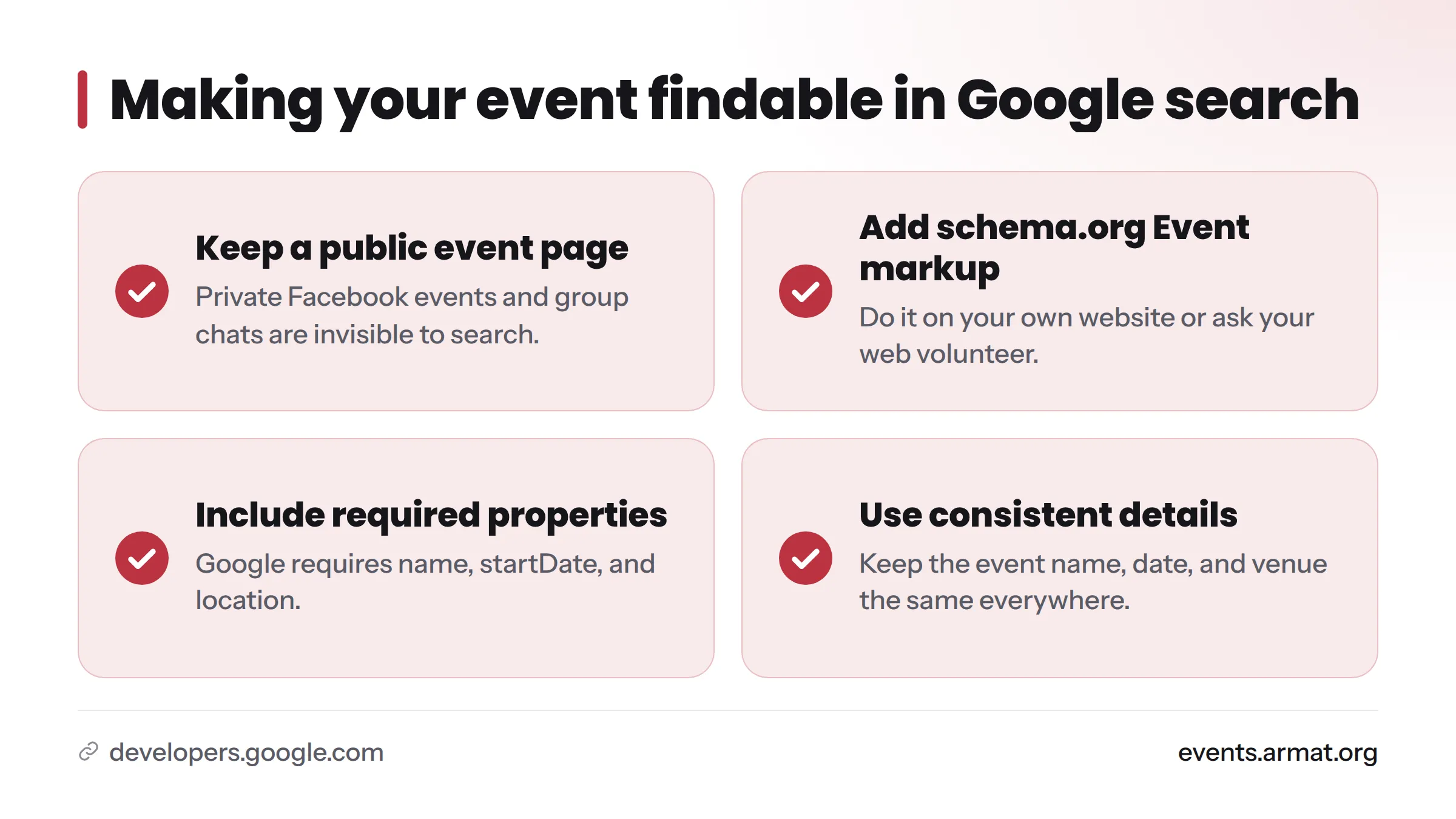
Many non-Armenians and younger Armenians start with a Google search like "Armenian events near me." According to Google Search Central's event structured data documentation, adding Event markup to a public event page helps people discover events through Google Search and Google Maps. Google lists name, startDate, and location as required properties.
What that means for you:
- Keep a public event page (an Armat listing, your website, or both). Private Facebook events and group chats are invisible to search.
- If you run your own website, add schema.org Event markup or ask your web volunteer to do it.
- Use the exact same event name, date, and venue everywhere. Conflicting details confuse both search engines and guests.
Event listing checklist
Before you publish, confirm your listing includes:
- A clear title (English, with the Armenian name in parentheses if there is one)
- Date, start time, and end time
- Full street address plus the neighborhood (Glendale, Van Nuys, Pasadena)
- Parking and transit notes
- Price, or "Free"
- Language or languages used at the event
- Age suitability (family-friendly, 21+, students)
- Accessibility details (step-free entry, seating, restrooms)
- Organizer name and contact
- One sharp, high-resolution image with readable text
- RSVP or ticket link
Know Who You're Trying to Reach
You can't reach "everyone." You can reach seven or eight specific groups, one at a time. The matrix below shows general patterns we see across the community. Treat them as starting points, not rules, and test them against what your own guests tell you. For the attendee side of this picture, see how attendees find Armenian community events in LA.
AudienceWhere they often get event infoBest languageMessage that landsArmenian-American familiesChurch bulletins, school newsletters, Facebook groups, emailEnglish, with Armenian titleFamily-friendly, heritage for the kids, easy parkingRecent arrivals from ArmeniaTelegram channels, Instagram, Armenian-language TV, friendsEastern Armenian, sometimes RussianArtists and music from Armenia, networking, practical valueIranian-Armenian communityWhatsApp and Viber groups, cultural centers, InstagramEastern Armenian, sometimes FarsiFamiliar music, family nights, community clubsLebanese-Armenian and Syrian-Armenian communityWhatsApp groups, organization chapters, parish lifeWestern Armenian, sometimes ArabicOrganization ties, choirs, scouting, reunionsStudentsInstagram, TikTok, ASA group chats, campus boardsEnglish with Armenian phrasesSocial, affordable, "bring a friend"Young professionalsInstagram, LinkedIn, professional society emailsEnglishNetworking, quality programming, a clear end timeChurch communitiesBulletins, announcements after the Divine LiturgyMatches the parishBlessing, fellowship, supporting the parishNon-Armenian neighborsGoogle, Eventbrite, city calendars, local Instagram accountsEnglish (Spanish in some areas)"Open to all," what to expect, what to wear> A note on the matrix: these are habits we see, not measured percentages. Nobody has a reliable survey of which app each LA Armenian segment uses, so don't quote numbers you can't source.
Younger audiences deserve special attention because they decide the future of your guest list. This piece on how young Armenians in LA are building community shows where they gather and what draws them.
Speak Their Language: Bilingual and Multilingual Promotion
Language is where most Armenian event promotion quietly loses people. Get it right and every group feels addressed.
Eastern vs. Western Armenian on flyers and posts
Eastern Armenian is the standard language of the Republic of Armenia and of Iranian-Armenians. Western Armenian is the diaspora form that grew out of communities in the Ottoman Empire and is spoken by most Lebanese-Armenian, Syrian-Armenian, and many older Armenian-American families. The two also differ in spelling: Armenia uses reformed Soviet-era orthography, while Western Armenian and Iranian-Armenian communities use classical spelling.
Why this matters on a flyer: a Western Armenian speaker reading Eastern pronunciation in Latin letters may not even recognize the word. Paregentan and Barekendan are the same festival. So are Hokehankist and Hogehankisd (a requiem service). When you write Armenian terms in English letters, pick one form and add the other in parentheses if your audience spans both.
My rule of thumb: if your event serves a single parish or organization, match its usual style. If you want the whole city, use English as the shared base and add Armenian in the script your largest target group reads most comfortably.
When to add English, Russian, or Farsi
- English: always. It's the one language nearly every LA guest shares, including grandchildren and non-Armenian spouses.
- Russian: worth adding for events aimed at recent arrivals from Armenia, many of whom grew up with Russian as a second language.
- Farsi: a thoughtful touch for events aimed at older Iranian-Armenian guests.
- Arabic: occasionally useful for Lebanese-Armenian and Syrian-Armenian elders.
Don't cram four languages onto one flyer. Make a clean English and Armenian version, then post short Russian or Farsi captions in the group chats where those speakers gather.
Writing for people who don't speak Armenian
Picture a coworker reading your post. Would they know what a madagh (also spelled matagh, a blessed meal offering shared after a church service) is? Would they know whether they're allowed to come? Spell it out:
- Explain any Armenian term in a few words the first time you use it.
- Say plainly: "Everyone is welcome. No Armenian language needed."
- Describe what happens: food, music, a short program, kids' activities.
- Skip insider shorthand like organization acronyms without their full names.
Bilingual flyer checklist
- English title large enough to read from six feet away
- Armenian title in one consistent script and spelling style
- Date written as "Saturday, June 13" rather than a number-only format
- Address and neighborhood in English
- A QR code linking to your Armat listing
- "Open to all" or "Free admission" if true
- Strong color contrast and no text over busy photos (the W3C's WCAG standards explain why contrast matters for readability)
- Alt text or a caption with the full details when posting the image online
Channels That Fill Seats at Armenian Community Events
Next steps: put that listing and flyer in front of each audience. For tactics on post copy and ad formats, our step-by-step guide to promoting your Armenian event in Los Angeles goes further. Here's the reach-focused view.
Instagram and TikTok for younger audiences
Instagram is where most student groups and young professional networks announce events. TikTok works well for behind-the-scenes clips: dance rehearsals, the kitchen crew, the band warming up. Post a collaboration post with your co-hosts so it appears on both accounts, and ask performers to share it with their followers.
Facebook Events and community groups
Facebook still reaches parents and grandparents, and its LA Armenian community groups remain busy. Create a public Facebook Event that links back to your Armat listing, then share it in groups whose rules allow event posts. Read each group's rules first. Admins remove spam fast.
WhatsApp, Viber, and Telegram group chats
Yes, they work, and for some audiences they are the main channel. WhatsApp and Viber groups carry a lot of family and organization news, and Telegram channels are popular with many recent arrivals from Armenia. The trick is a short message that travels well when forwarded:
**Group chat template:**Join us Saturday, [date], at [venue], [neighborhood], for [event name]. [One line on what it is]. Free / $[price]. Everyone welcome. Details and RSVP: [Armat link]
Keep it under 50 words, put the link last, and ask three trusted people to forward it to their own groups.
Email lists and newsletters
Email is the one channel you own. Use a free tool like Mailchimp or your existing platform, send a save-the-date and one reminder, and always include the listing link. Ask partner organizations to include your event in their newsletters too.
Local Armenian media and community calendars
Outlets such as Asbarez and The California Courier cover community life, and Armenian-language TV and radio stations in LA reach older and Armenian-first viewers. Each has its own process for announcements and press releases, so check their current submission instructions directly. Don't rely on an old contact someone forwarded years ago.
Mainstream LA news sometimes covers big festivals too. This short CBS LA segment on the Pasadena Armenian Festival shows the kind of story that earns local TV attention: food, culture, and an open invitation to the public.
https://www.youtube.com/watch?v=4JuJKwjc_qs
Print still works: church bulletins, bakeries, cafés, and community boards
A flyer on the counter of a busy Glendale bakery or a Little Armenia café reaches people who never open Instagram. Ask permission, bring a small stack, and include the QR code. The Glendale Public Library and neighborhood community boards are worth a stop too.
Channel comparison
ChannelCostBest audienceLead timeEffortArmat Platform listingFree to start (confirm current terms on the site)Everyone searching for Armenian events in LA6 to 8 weeksLowInstagram and TikTokFree; paid boosts optionalStudents, young professionals3 to 4 weeksMediumFacebook Events and groupsFreeParents, older adults, organization members4 to 6 weeksLowWhatsApp, Viber, TelegramFreeFamilies, recent arrivals, organization members1 to 2 weeksLowEventbriteFree listing for free events; fees on paid ticketsNon-Armenian guests, ticket buyers4 to 6 weeksMediumEmail newslettersFree to low costPast attendees, partner members4 to 6 weeksMediumChurch bulletinsFreeParishioners3 to 4 weeksLowLocal Armenian mediaVaries; check each outletArmenian-first readers and viewers4 to 8 weeksMediumPrint flyers on community boardsPrinting costNeighbors, walk-in shoppers3 to 4 weeksHighI put Armat Platform first for a reason: it's the only channel on this list built for the whole Armenian Los Angeles community at once, and every other channel can point back to it.
Partner Up: Churches, Schools, Student Groups, Nonprofits, and Businesses
Partners are the fastest way out of your own circle. One co-host can double your reach overnight, because their audience trusts them.
Churches and parish bulletins
Parishes reach families every Sunday. The Western Diocese of the Armenian Church oversees many local parishes, and individual churches such as St. Leon (Ghevontiants) Armenian Cathedral in Burbank, St. Gregory Armenian Church of Pasadena, and St. Peter Armenian Church of Van Nuys each run their own calendars. Armenian Catholic and Armenian Evangelical congregations have their own networks too.
To get into a bulletin, contact the parish office three to four weeks ahead, send a two-sentence blurb plus your listing link, and ask whether the pastor would mention it during announcements. Respect parish priorities. Fundraisers for other causes may need approval.
Armenian schools and parent networks
Armenian day schools have tight parent networks that pass news fast. Schools like the Armenian Mesrobian School and Armenian Sisters' Academy communicate through newsletters and parent groups. Family events, children's performances, and cultural workshops fit naturally. Offer a discount code for school families or invite a student group to perform.
University ASAs and young professional groups
Want students? Go through the people they already follow. The UCLA Armenian Students' Association and USC Armenian Student Association both list events on Armat. For a wider view, see this overview of Armenian student organizations in LA. Graduates stay reachable through groups like the CSUN Armenian Alumni Network, and The Armenian Professional Society reaches working professionals across fields.
Professional associations and nonprofits
The Armenian Bar Association and the Armenian American Medical Society reach professionals who often have budgets for galas and panels. Long-standing community organizations such as AGBU, Hamazkayin, Homenetmen, the Armenian Relief Society, and the Armenian Youth Federation each have chapters with loyal members. A joint event or a simple cross-post between two organizations reaches audiences neither could reach alone.
Armenian-owned businesses as promotion partners
Bakeries, restaurants, salons, and shops see hundreds of community members a week. Ask a business to display your flyer, donate a raffle prize, or sponsor in exchange for a logo on your listing. Start with this guide to Armenian-owned businesses in LA to find partners near your venue.
Partner outreach email template
Subject: Co-promote [Event Name] on [Date]?

Hi [Name],

I'm [your name] with [organization]. On [date], we're hosting
[event name] at [venue] in [neighborhood]: [one sentence on what it is].

We'd love to reach your [members / parishioners / students]. Would you
be open to sharing it in your [newsletter / bulletin / Instagram]?
In return, we'd [list you as a community partner / share your next
event / offer your members a discount].

Event details: [Armat listing link]

Thank you,
[Name, phone]
Timing Your Event Around the Armenian Calendar
A great event on the wrong date competes with church, family, and other organizations. A smart date rides a moment people already care about.
Dates to plan around
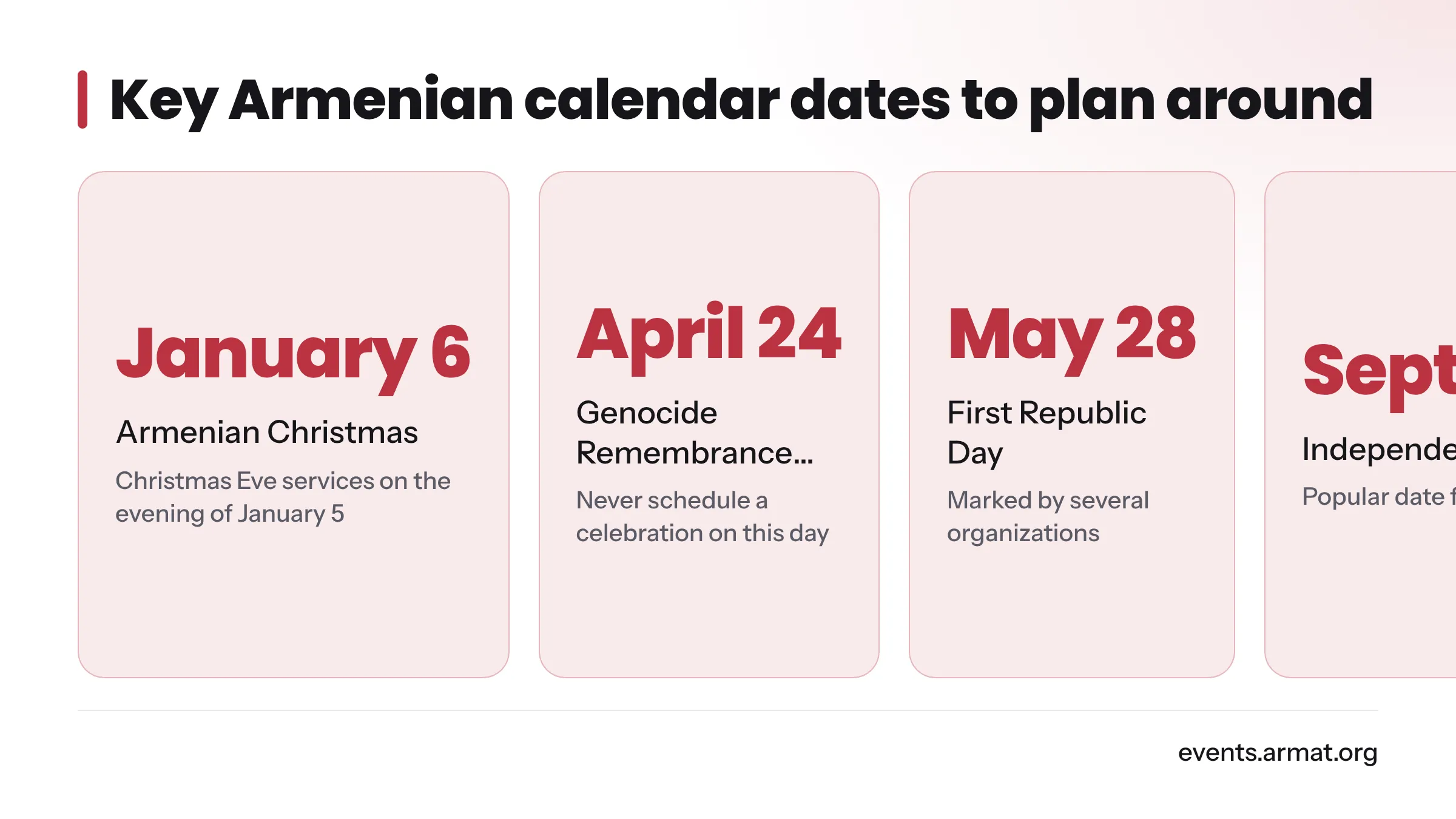
- January 6: Armenian Christmas (Surb Tsnund). The Armenian Apostolic Church celebrates the Nativity and Theophany together on January 6, with Christmas Eve services on the evening of January 5. Avoid scheduling against either.
- Easter (Zatik) and Holy Week. The date moves each year. Check the Western Diocese's official site for the current liturgical calendar.
- April 24: Armenian Genocide Remembrance Day. Commemorations take place across Los Angeles. Never schedule a celebration, party, or fundraiser gala on this day. If your event is a commemoration, keep the tone dignified and the language plain.
- May 28: First Republic Day, marked by several organizations.
- September 21: Independence Day of the Republic of Armenia, a popular date for cultural programs.
- Parish feast days: each church has its own name-day feast and festival weekend. Ask nearby parishes before picking a weekend.
Seasonal moments that draw crowds
- Barekendan (Paregentan): a festive day of food and fun before Great Lent begins. Good for family parties and costume nights.
- Vardavar: the summer feast of the Transfiguration, held 98 days after Easter, famous for water splashing. Kids and young adults love it.
- The Feast of the Assumption and the Blessing of the Grapes: held on the Sunday nearest August 15, a natural tie-in for picnics and madagh gatherings.
- Navasard: the ancient Armenian New Year in August, which some cultural groups revive as a festival theme.
- April observances: Glendale and California have recognized April as Armenian history and heritage month in past years. Verify the current designation with the City of Glendale before using it in promotion.
- Fall festival season: many church festivals cluster in September and October, which means big crowds and heavy competition.
Want ideas for modern takes on these moments? See how young Armenians are reviving cultural traditions in LA.
Avoid clashing with other community events
Before you lock a date, check the events already listed on Armat Platform for the same weekend and neighborhood. Then call one or two organizations whose audience overlaps yours. A five-minute call can save both events from splitting the crowd.
SeasonMomentsScheduling tipJanuaryChristmas (Jan 6), New Year gatheringsAvoid Jan 5 to 6; post-holiday dinners work wellLate winterBarekendan, start of LentFestive events before Lent; lighter menus duringSpringEaster (varies), April 24, April observancesKeep April 24 for remembrance onlySummerVardavar, Blessing of the Grapes, NavasardOutdoor and family events thriveFallSeptember 21, festival seasonCheck Armat early; weekends fill fast## A Promotion Timeline That Works (8 Weeks Out to the Day After)
Let's break it down. This countdown fits most community events, from a parish picnic to an ASA cultural night.
WhenWhat to do8 weeks outPublish your Armat listing, confirm partners, lock the venue details6 weeks outSend a save-the-date by email and post it on Instagram and Facebook4 weeks outLaunch the full flyer, post in community groups, submit to bulletins and media2 weeks outPost reminders, share partner content, drop flyers at businesses1 week outPush to WhatsApp, Viber, and Telegram groups; send a reminder emailDay ofPost stories and short clips; welcome walk-insDay afterSend a thank-you with photos and the next dateFirst-time organizers can start at four weeks out and still do fine. Large festivals and galas should start at twelve.
Make Newcomers and Non-Armenians Feel Welcome
Reaching new people only matters if they want to come back. The welcome starts in your description.
What to say in your description so first-timers feel invited
Say who it's for, what happens, and what guests need to know. "Open to everyone, Armenian or not. The program is in English and Armenian. Come hungry. Kids welcome." Four short sentences remove most of the hesitation a first-timer feels.
Day-of touches
- Put two friendly greeters at the door who can switch between English and Armenian.
- Use bilingual signs for check-in, restrooms, and food.
- Have the emcee explain each tradition in a sentence before it happens.
- Set up a kids' corner so parents can actually enjoy the program.
Inclusive programming widens your reach too. Groups like the GALAS LGBTQ+ Armenian Society show how many Armenians are looking for spaces where they feel fully welcome.
Accessibility and welcome checklist
- Step-free entry or a clear note about stairs
- Seating for elders and people who can't stand long
- Accessible restroom location noted
- Readable signs with large text
- Program language listed in advance
- Contact person for access requests
For general guidance on accessibility obligations, ADA.gov is the federal starting point.
Turn One-Time Guests Into Regulars
The cheapest way to reach more people next time is to keep the people you reached this time.
Collecting contacts the right way
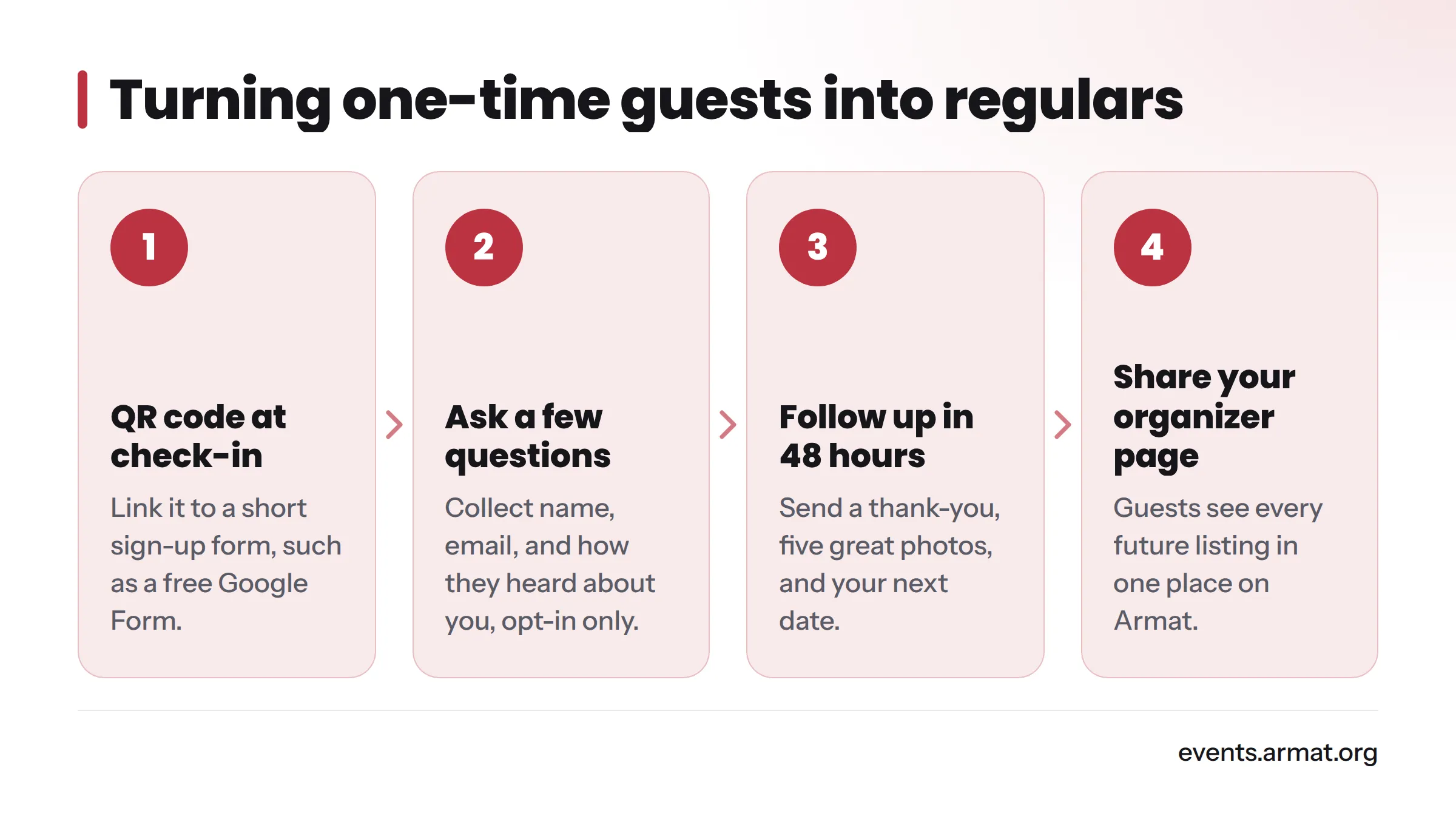
Place a QR code at check-in linking to a short sign-up form (a free Google Form works). Ask for name, email, and "How did you hear about us?" Make it opt-in, say what you'll send, and never add people to group chats without asking.
Following up with photos, a thank-you, and the next date
Within 48 hours, send a short note: thank you, five great photos, and the date of your next event. People forward photos of themselves. That forward is free promotion to their circle.
Following your organizer page on Armat
Point guests to your Armat organizer page so they see every future listing in one place. Established organizers like the Armenian Film Society keep their pages current, which builds a returning audience over time.
How to Tell What's Working
You don't need a dashboard. You need four numbers.
Simple metrics
- RSVP vs. attendance: if 200 RSVP and 120 come, expect a similar gap next time and plan food accordingly.
- "How did you hear about us?": ask at check-in or on the sign-up form.
- UTM links: add tags to each link so you can see which channel sent visitors. Google's free Campaign URL Builder creates them in seconds.
- Ticket source: most ticketing tools show where buyers came from.
Troubleshooting
ProblemLikely causeFixLow RSVPs two weeks outPromotion stayed in one channelAsk every partner to post this week; push group-chat messageOnly older or only younger attendeesLanguage and channel matched one generationAdd Instagram for youth, bulletins and Facebook for eldersLast-minute surge overwhelms the doorGroup chats spread late; no RSVP requiredAdd a simple RSVP; staff an extra greeterWrong date or time circulatingOld flyer forwarded in chatsPost a correction pinned to your listing; reshare the right flyerLanguage mismatchFlyer in one dialect or script onlyUse English base plus consistent Armenian## Beginner vs. Established Organizers: Where to Focus
Not every organizer has the same resources. Pick the path that fits you.
- Volunteer-run, little or no budget (a new ASA, a small nonprofit, a parish committee)
- Free Armat listing
- Two or three partners
- Group chats and Instagram
- A sign-up QR code at the door
- Established, with a budget (a festival, a professional society, a large organization)
- Everything above, plus:
- Paid social boosts aimed at LA neighborhoods
- Sponsor activations with Armenian-owned businesses
- Media outreach and a press release
- Event schema on your website and UTM tracking on every link
Do you need an event marketing agency? Most community events don't. Agencies make sense for large ticketed productions. For everything else, partners and a solid listing outperform a big spend.
FAQ
Start with Armat Platform, which is built for LA's Armenian community. Free public Facebook Events, free Eventbrite listings for free events, church bulletins, and partner newsletters also cost nothing.
Both, in most cases. Use English as the shared base so everyone can read the details, then add Armenian in one consistent script and spelling style. Add Russian or Farsi captions in group chats when targeting those speakers.
Partner with university ASAs and young professional groups, post on Instagram and TikTok, keep prices low, and ask attendees to bring a friend.
Six to eight weeks for most events. Twelve weeks for festivals and galas. Four weeks is the minimum for a small gathering.
Contact the parish office three to four weeks ahead with a two-sentence blurb and your listing link. Ask whether the pastor can mention it in announcements.
Say "open to all" clearly, explain traditions in plain English, list on platforms they search, and greet them warmly at the door.
April 24 for any celebration, January 5 and 6, Holy Week and Easter, and your neighboring parishes' festival weekends. Check Armat for existing events before choosing.
Usually not. Community events grow faster through partners, listings, and group chats. Consider an agency only for large ticketed productions.
Ask "How did you hear about us?" at check-in, use UTM-tagged links for each channel, and compare RSVPs to attendance.
Get Your Event in Front of the Community
Armenian Los Angeles is big, generous, and ready to show up. It just needs to hear about you, in its own language, from people it trusts, on a date that makes sense.
Your next step is simple: list your event on Armat Platform, then share that one link with every partner, group chat, and bulletin on your list. For deeper tactics, revisit the Armenian event promotion playbook for Los Angeles and our wider guide to growing your audience. Then browse the organizer pages above and reach out to one potential partner this week.
Written by the Armat Platform editorial team, which curates Armenian event and organizer listings across Los Angeles and works with churches, student associations, and community organizations every week.
Sources
- Event (Event, EducationEvent) Structured Data, Google Search Central
- Event, Schema.org
- WCAG Standards and Guidelines, W3C Web Accessibility Initiative
- ADA.gov, U.S. Department of Justice
- Explore Census Data, U.S. Census Bureau
- Western Diocese of the Armenian Church of North America
- Armenians in Los Angeles, Wikipedia
- Campaign URL Builder, Google Analytics Demos and Tools