
How To Find Armenian Community Organizations Near You
The fastest way to find Armenian community organizations near you is to use five sources at once: an Armenian community directory like Armat Platform, your nearest Armenian church, the chapter pages of national groups such as AGBU and Homenetmen, your campus Armenian Students' Association, and public events like food fairs and cultural nights. Each source catches groups the others miss.
So who is this guide for? Anyone looking for that connection. You might be a fourth-generation Armenian-American whose grandparents spoke the language when you never did. You might have arrived from Yerevan, Tehran, or Beirut last month. Or you might not be Armenian at all and simply want to know who's behind the food festival down the street. At Armat, we hear from all three kinds of people every week.
Armenian organizations exist in far more places than most people realize. The catch is how they advertise: word of mouth, Instagram stories, and Armenian-language flyers taped to church doors. This guide puts that scattered information in one place.
Last updated: October 2026
The Short Answer: 7 Ways to Find Armenian Organizations Near You
- Search an Armenian community directory. Armat Platform lists organizers and events across Southern California and beyond, and each group's page shows its upcoming events.
- Start with the closest Armenian church or parish. Churches work as the community's front door, even for people who aren't religious.
- Check the chapter and location pages of national groups. AGBU, the Armenian Relief Society, Homenetmen, and Hamazkayin all run local chapters.
- Look for an Armenian Students' Association (ASA) at your college. Campus clubs welcome students of any background.
- Go to a public Armenian event. Festivals, food fairs, book fairs, and cultural nights make the easiest first contact.
- Search social media with the right words. Use Armenian-specific terms and follow local groups on Instagram and Facebook.
- Ask in person. Armenian bakeries, markets, schools, and public libraries usually know what's happening nearby. Our guide to Armenian-owned businesses in Los Angeles can help you pick a place to ask.
The Kinds of Armenian Community Organizations You'll Run Into
Knowing what you're looking for makes the search much shorter. Armenian community life runs through a handful of organization types, and they overlap constantly. A single church might host a Saturday school, a scout troop, and a ladies' auxiliary under one roof.
Churches and Parishes (Armenian Apostolic, Catholic, Evangelical)
A parish is a local church congregation. Most Armenian churches belong to the Armenian Apostolic Church, one of the oldest Christian churches in the world. Armenia adopted Christianity as its state religion in the early fourth century, a date tradition places at 301. Armenian Catholic and Armenian Evangelical congregations exist too. Services are only part of the picture: churches also run youth groups, choirs, Sunday school, picnics, and food fairs.
Armenian Cultural Organizations and Arts Groups
Armenian cultural organizations run dance ensembles, theater troupes, choirs, lectures, film screenings, and book fairs. The Hamazkayin Armenian Educational and Cultural Society and the Tekeyan Cultural Association are two long-running groups with chapters across the diaspora. Smaller collectives, like the organizers behind Armenian Arts, post exhibitions and performances on Armat.
Armenian Nonprofits: Benevolent and Relief Organizations
A benevolent union funds education, culture, and humanitarian work. The Armenian General Benevolent Union (AGBU) started in Cairo in 1906 and now runs chapters, schools, and young professional networks around the world. The Armenian Relief Society, founded in New York in 1910, works through local chapters on social services, education, and relief.
Armenian Youth Groups, Scouts, and Athletic Clubs
Homenetmen, the Armenian General Athletic Union and Scouts, began in Constantinople in 1918. Today it runs scouting troops and sports leagues (basketball, soccer, volleyball, track) in many U.S. cities. The Armenian Youth Federation and AGBU's youth programs add camps, leadership training, and social events. Many of these groups meet at an agoump, the Western Armenian word for clubhouse (akumb in Eastern Armenian).
Day Schools and Saturday Language Schools
Armenian day schools teach a full K-12 curriculum alongside Armenian language, history, and culture. A Saturday school is a weekend program, often held at a church or community center, where kids who attend public or private school during the week learn to read, write, and speak Armenian. For parents asking "how can my kids learn Armenian?", the Saturday school is the most common answer.
Armenian Student Associations
Most large universities with Armenian students have an ASA. These clubs organize cultural nights, mentoring, commemorations, and socials. Bigger campuses often have pre-professional offshoots too, like pre-law and pre-med groups.
Armenian Professional Associations
Doctors, lawyers, engineers, and entrepreneurs each have their own Armenian networks. The Armenian American Medical Society and the Armenian Bar Association are two established Armenian professional associations.
Affinity and Identity Groups (LGBTQ+, Women's, Young Professionals)
Affinity groups bring people together around a shared identity or stage of life. GALAS LGBTQ+ Armenian Society, women's auxiliaries, and young professional socials all belong here.
Hometown (Compatriotic) Associations
A compatriotic union gathers families whose ancestors came from the same town or region, such as Marash, Kessab, Urfa, or Musa Dagh. Genocide survivors founded many of them to keep local traditions, dialects, and recipes alive. Members often welcome descendants who want to learn their family's story.
Armenian Organization Types at a Glance
| Organization type | Who it serves | Typical activities | Language used | How to join |
|---|---|---|---|---|
| Church / parish | Families, faith seekers, anyone curious | Divine Liturgy (Badarak), Sunday school, picnics, food fairs | Classical Armenian liturgy; English and Armenian announcements | Attend; register as a parish member if you wish |
| Cultural / arts society | Artists, audiences, students | Dance, theater, lectures, book fairs | Mixed; often bilingual | Attend events; chapter membership |
| Benevolent / relief union | Adults, donors, volunteers | Fundraisers, scholarships, social services | Mostly English plus Armenian | Chapter membership, volunteering |
| Youth / scouts / athletics | Kids, teens, families | Scouting, sports leagues, camps | Mixed; varies by chapter | Register through the local chapter |
| Day school / Saturday school | Children ages 4 to 18 | Language, history, music, dance | Armenian instruction | Enroll; contact the school office |
| Student association | College students | Cultural nights, mentoring, socials | English | Sign up at club fairs or social media |
| Professional association | Doctors, lawyers, business owners | Networking, scholarships, conferences | English | Paid membership; open events |
| Affinity group | LGBTQ+, women, young professionals | Socials, support, advocacy | English | Attend events; mailing list |
| Compatriotic union | Descendants of a hometown | Annual dinners, picnics, oral history | Mixed; often Western Armenian | Contact the group; family ties welcome |
Looking for names and websites? Our guide to Armenian cultural organizations in Los Angeles lists them in detail.
How Armenian Churches Are Organized (Without the Confusion)
Most people start their search at a church, so a minute on church structure saves a lot of head-scratching later.
Why Two Nearby Armenian Apostolic Churches May Belong to Different Bodies
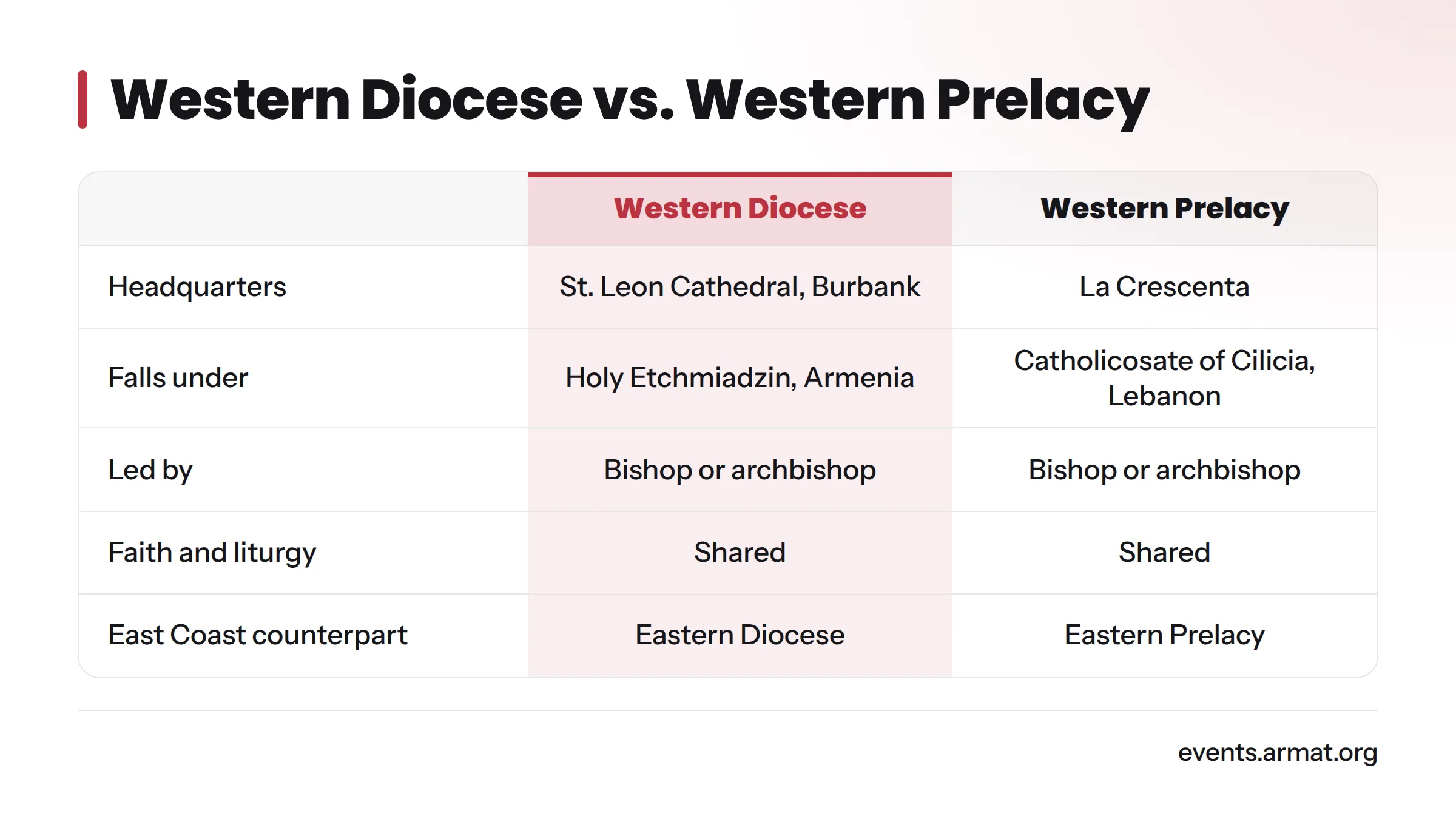
Here is why. In the western United States, each Armenian Apostolic parish belongs to one of two jurisdictions:
- The Western Diocese of the Armenian Church, headquartered at St. Leon Armenian Cathedral in Burbank, falls under the Catholicos of All Armenians at Holy Etchmiadzin in Armenia.
- The Western Prelacy of the Armenian Apostolic Church, headquartered in La Crescenta, falls under the Catholicosate of the Great House of Cilicia in Antelias, Lebanon.
A diocese and a prelacy are both regional church administrations led by a bishop or archbishop. The two bodies separated in the United States in the 1930s for historical reasons. Today they share the same faith, liturgy, and sacraments. For a newcomer, the practical difference is small, so choose the parish whose people, location, and programs suit you. You can browse events from the Western Diocese and its parishes on Armat.
The East Coast mirrors this setup, with the Eastern Diocese and the Eastern Prelacy each serving their own parishes.
Armenian Catholic and Armenian Evangelical Congregations
Armenian Catholic churches are in communion with Rome but follow the Armenian rite, so their services look and sound familiar to Apostolic worshippers. Armenian Evangelical churches are Protestant congregations with Armenian roots, often with English-language services and busy youth ministries. Both host community events open to everyone.
Do You Need to Be Armenian or Orthodox to Attend?
No. Armenian churches welcome visitors of any background. Communion may be reserved for church members, so if you're unsure, stay seated and watch. Nobody will mind.
Churches double as community centers. Beyond Sunday's Divine Liturgy (Badarak in Western Armenian, Patarag in Eastern), most parishes run Sunday school, youth groups, choirs, picnics, and an annual food fair. Women's groups like the Western Diocese Armenian Church Ladies Auxiliary organize many of the luncheons and fundraisers that bring the whole community together.
Step by Step: Finding Armenian Organizations Near You
Let's break it down. This method works in Glendale, in Fresno, in Chicago, or in a small town whose only parish sits two counties away.
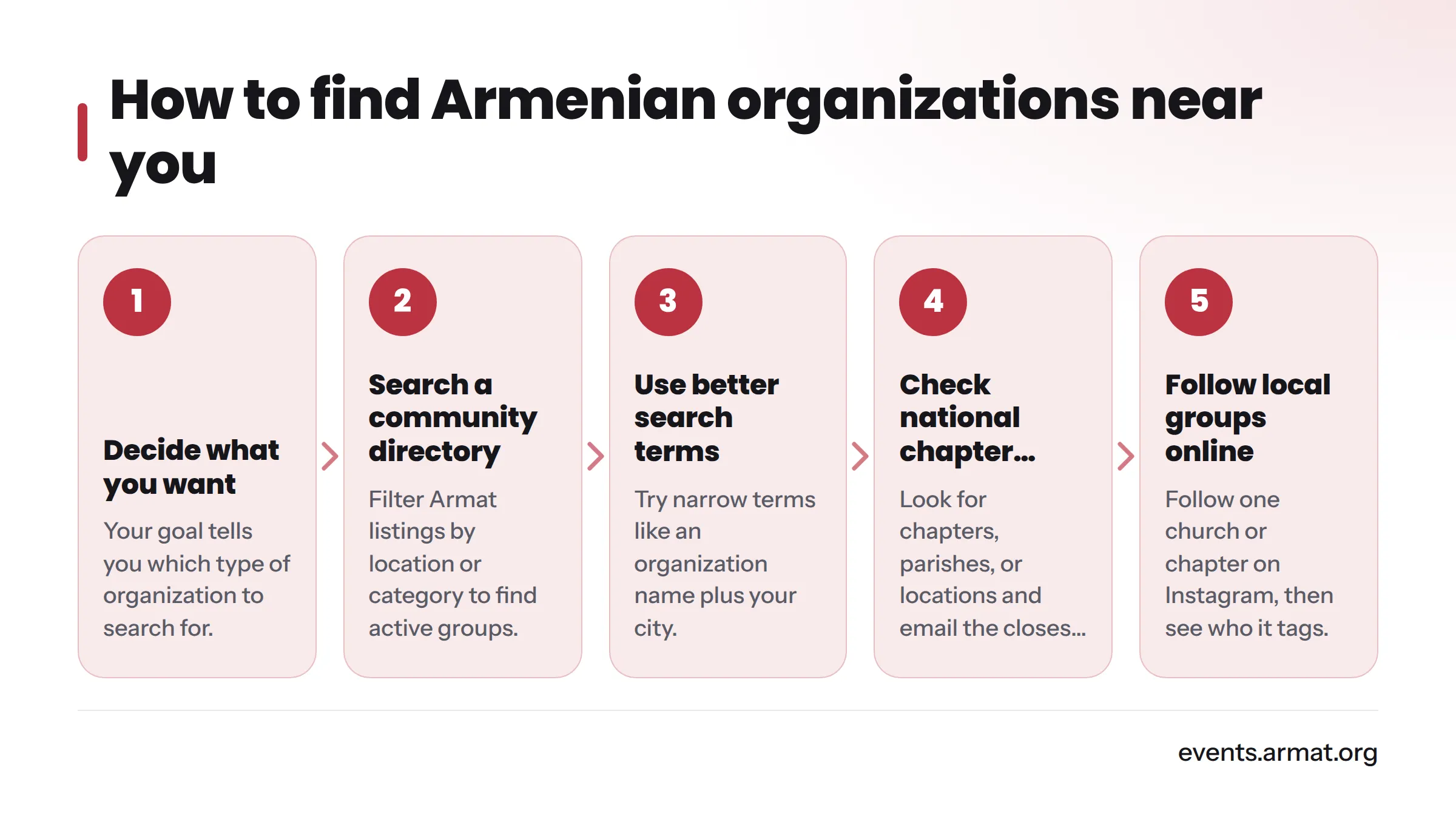
Step 1: Decide What You Want
Finish this sentence: "I want ___." Armenian lessons for my kids? A career network? Faith? Friends my age? Your answer tells you which type of organization to search for.
Step 2: Search an Armenian Community Directory
Open Armat's organizer and event listings and filter by location or category. A directory beats a general search engine because it surfaces active groups with real upcoming events instead of a church website nobody has touched in years.
Step 3: Use Maps and Search Engines with Better Terms
Typing "Armenian organizations near me" usually returns a jumble of loosely related results. Narrower terms work better. Try these in Google Maps or any search engine:
- "Armenian church near me" or "Armenian Apostolic church"
- "Armenian schools near me" or "Armenian Saturday school"
- "Homenetmen" plus your city
- "AGBU" plus your city
- "ARS" or "Armenian Relief Society" plus your city
- "Armenian Students Association" plus your university
- "Armenian community center near me" or "Armenian center"
- "Hye" plus "night" or "social" (Hye means Armenian; the Eastern spelling is Hay)
Step 4: Check National Chapter Pages
National bodies list their local branches online. Visit the AGBU, ARS, Homenetmen, and church jurisdiction websites, look for "chapters," "parishes," or "locations," and email the closest one.
Step 5: Follow Local Groups on Instagram and Facebook
Most Armenian groups post more on Instagram than on their own websites. Follow one local church or chapter, then look at who it tags and follows. Within a week or so, your feed starts working like a community calendar. Facebook Groups named "Armenians in [your city]" are good for recommendations too.
Step 6: Go to a Public Event First
A festival or cultural night lets you meet several organizations in one evening with no commitment. Our guide on how to find Armenian community events near you shows the best ways to keep track of them.
Step 7: Reach Out, Then Show Up
Send a short message (there's a template below), then go. Introduce yourself to whoever is sitting at the welcome table. In my experience, that one conversation tends to lead to three more.
Find Your Armenian Community Checklist
- Write down your goal (faith, language, kids, career, culture, service, identity)
- Search Armat listings for your area
- Run a map search with at least three specific terms
- Check two national organizations' chapter pages
- Follow three local groups on Instagram
- Pick one public event this month
- Send one introduction message
- Attend, say hello, and ask "What else should I know about?"
Match the Organization to Your Goal
I think this is where most people get stuck. They find a list of 40 names and have no idea which one to call. Starting with your goal cuts that list down fast.
| Your goal | Organization type | Where to look |
|---|---|---|
| My kids should learn Armenian | Saturday school, day school, scouts | Church offices, school websites, Armat organizers |
| I want faith and spiritual community | Parish | Diocese or prelacy parish directory |
| I need a career network | Professional association, young professional group | AAMS, Armenian Bar Association, AGBU networks |
| I'm a college student | ASA, pre-professional clubs | Campus club directory, Instagram |
| I just arrived | Church, relief society, community center | Parish office, ARS chapter, city services |
| I'm curious but not Armenian | Cultural events, festivals | Armat event listings |
| I want LGBTQ+ community | Affinity group | GALAS |
| I make art, music, or books | Cultural society, arts collective | Hamazkayin, Tekeyan, Armenian Arts |
For Families and Parents
Families tend to start with a day school, a Saturday school, or a scout troop. In Southern California, the Armenian Mesrobian School posts its community events on Armat. Ask any parish office about a Saturday school; most run one or can point you to the closest. Kids who love the outdoors often gravitate to Homenetmen scouting, where they get camping trips and Armenian friends in the same package.
For Students
Look up your school's ASA in the first week. In Los Angeles, the UCLA Armenian Students' Association and the USC Armenian Student Association keep full calendars. Pre-law students can check out the Armenian Pre-Law Student Association at UCLA, and our roundup of Armenian student organizations in LA covers more campuses. Academic centers like the USC Dornsife Institute of Armenian Studies and the UCLA Promise Armenian Institute also hold public lectures.
For Young Professionals
Networking events and socials are where young professionals usually find their footing. Watch for gatherings like The Armenian Professional Forum 2026 and casual meetups such as Yerevan Nights, a Hye Night social. For the wider picture, read about young Armenians building community in LA.
For Recent Arrivals from Armenia, Iran, Lebanon, Syria, and Elsewhere
Start with a parish. Priests and parish councils often know who has housing, who's hiring, which schools to consider, and which doctors speak Armenian. Relief society chapters and community centers help with practical needs. In Glendale, city programs like Youth & Family Services at Glendale Community Services & Parks run activities that many Armenian families use.
For Non-Armenians and the Culture-Curious
You're welcome here. Go to a food fair, a cultural night, or a book fair, and bring a friend if that makes it easier. Ask questions. In my experience, people are happy to explain where a dance or a dish comes from.
For Those Seeking Faith and Spiritual Community
Visit two or three parishes before you settle on one. Notice the language of the sermon, the size of the youth program, and how people greet you after the service. Those details matter more day to day than which jurisdiction the parish belongs to.
For LGBTQ+ Armenians
GALAS LGBTQ+ Armenian Society has served LGBTQ+ Armenians and their allies in Southern California for decades through social events, support, and cultural programs.
For Artists, Musicians, and Writers
Cultural societies always need performers, designers, and writers. Browse Armenian cultural events to see who's presenting work, then introduce yourself to the organizers after a show.
Armenian Organizations in Los Angeles: Where to Look by Neighborhood
Greater Los Angeles is home to the largest Armenian community in the United States. Current ancestry estimates are available through the U.S. Census Bureau's American Community Survey on data.census.gov. For the history behind each area, see our piece on Armenian neighborhoods in Los Angeles.
Glendale
Glendale is the center of Armenian Southern California, with dozens of churches, schools, bakeries, and community centers within a few miles of each other. The City of Glendale offers bilingual services, and the public library carries Armenian-language collections and programs. If you live here, finding organizations won't be the problem. Choosing among them will.
Burbank
Burbank is home to St. Leon Armenian Cathedral and the Western Diocese headquarters. The cathedral complex hosts cultural programs, youth events, and large community gatherings throughout the year.
Pasadena and La Crescenta
Pasadena has Armenian churches, day schools including the AGBU Vatche and Tamar Manoukian High School, and active chapters of several community groups. La Crescenta houses the Western Prelacy offices, and Armenian families make up a large share of the schools and parishes in the foothill communities.
Hollywood and Little Armenia
The Los Angeles City Council designated Little Armenia in East Hollywood in 2000. Roughly bounded by Hollywood Boulevard, Vermont Avenue, Santa Monica Boulevard, and Western Avenue, the area holds churches, community centers, markets, and restaurants that served earlier waves of immigrants and still welcome new ones.
Montebello and the Eastside
Montebello has one of the oldest Armenian communities in LA County. Bicknell Park holds the Armenian Genocide Martyrs Monument, dedicated in 1968, where many people gather each April 24. The Armenian Mesrobian School sits nearby in Pico Rivera, and Holy Cross Armenian Church shares parish events on Armat, including its Food Fair & Fest. The Holy Cross Armenian Church organizer page has its latest schedule.
San Fernando Valley (Granada Hills, Encino, North Hollywood)
The Valley has its own churches, day schools like Ferrahian Armenian School in Encino, Homenetmen chapters, and senior services such as Ararat Home in Mission Hills. North Hollywood and Van Nuys have growing communities of young families as well.
Want every group listed by name? Our Los Angeles organizations guide has the full list.
Outside Los Angeles? Finding Armenian Organizations in Other Cities
The same seven steps work anywhere. These are the places with the deepest roots.
Major U.S. Armenian Hubs
- Greater Boston and Watertown, Massachusetts: One of the oldest Armenian-American communities, with churches, schools, the Armenian Museum of America, and NAASR's headquarters in nearby Belmont.
- New York and New Jersey: St. Vartan Cathedral in Manhattan is the seat of the Eastern Diocese, and North Jersey has a dense network of parishes and schools.
- Fresno, California: Armenians have lived in the Central Valley since the late 1800s. Fresno State runs an Armenian Studies Program, and local parishes host well-attended picnics.
- San Francisco Bay Area: Active churches, schools, and cultural events, including the Golden Gate Armenian Film Festival.
- Detroit area and Chicago: Established parishes, AGBU and ARS chapters, and community centers in the suburbs.
For a visual overview of where Armenian communities cluster across the country, this video from Diaspora Compass walks through the largest ones.
When There's No Armenian Community Nearby
It happens, and you still have options:
- Find the nearest parish, even if it's two hours away. Many priests hold monthly services in towns that don't have a church of their own.
- Join a national chapter remotely. AGBU and several professional associations run virtual programs.
- Plan around regional festivals. A single annual picnic can introduce you to people from across a whole region.
- Go online. Facebook Groups, Discord servers, and virtual Armenian language classes fill the gaps between visits.
Your First Visit: What to Expect
I'll be honest: walking in the first time is the hardest part. After that, it gets easier quickly.
Do You Need to Speak Armenian?
No. Most organizations in the U.S. run in English or move back and forth between English and Armenian. The language has two main standard forms. Eastern Armenian is spoken in Armenia and by Iranian-Armenians. Western Armenian comes from diaspora communities rooted in the former Ottoman lands, Lebanon, and Syria. Spellings differ as a result of those two traditions: Sourp and Surp both mean Saint, and Vartanantz and Vardanants name the same feast. Speakers of the two forms understand each other reasonably well, and no group will turn you away for speaking only English.
Church Etiquette for First-Time Visitors
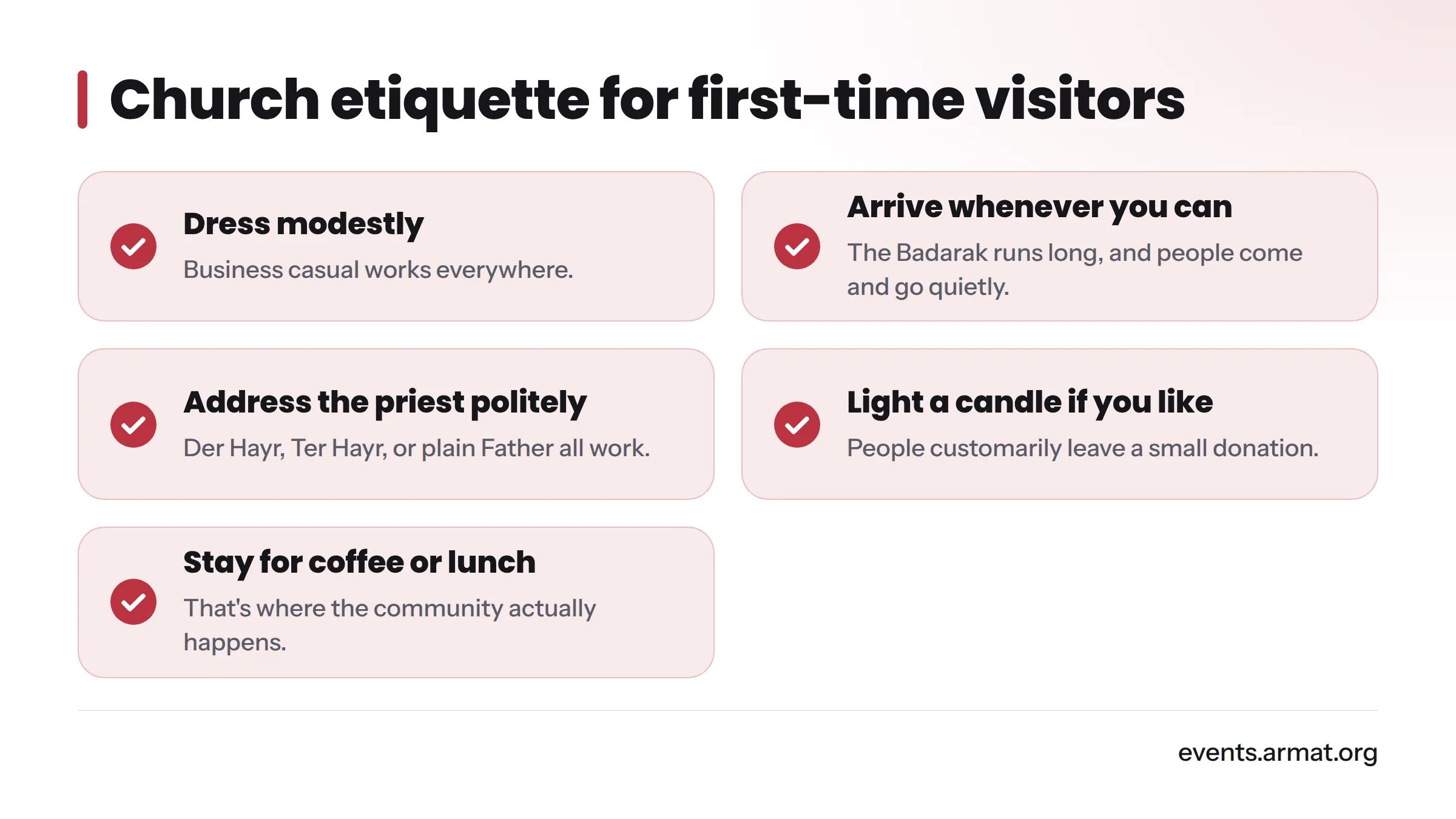
- Dress modestly; business casual works everywhere.
- Arrive whenever you can. The Badarak runs long, and people come and go quietly.
- A married priest is addressed as Der Hayr (Western pronunciation) or Ter Hayr (Eastern), literally "Lord Father." Plain "Father" works too.
- Light a candle at the entrance if you like; people customarily leave a small donation.
- Stay for coffee or lunch afterward. That's where the community actually happens.
The Easiest First Events
My personal favorite first event is a church food fair: music, families everywhere, and nobody asks why you came. A close second and third are an Armenian Cultural Night and an Armenian Book Fair. If you end up at a dinner, a quick read on traditional Armenian toasts will help you join in when the glasses go up.
Contact message template (email or DM)
Hi! My name is [your name], and I live in [neighborhood]. I'm interested in [Saturday school for my 7-year-old / volunteering / joining your young professionals group]. I [do / don't] speak Armenian. Is there an upcoming event or a good time to visit? Thank you!
How to Join an Armenian Organization, Volunteer, or Become a Member
What Membership Looks Like
Dues vary widely. Some churches ask for an annual stewardship pledge, chapters charge yearly dues, and student clubs are often free. Ask each organization directly, since amounts change. Before you donate, you can confirm a nonprofit's 501(c)(3) status with the IRS Tax Exempt Organization Search.
Volunteering at Events
Every festival needs people for setup, food booths, parking, and kids' activities. Volunteering is the quickest way I know to meet people, because you're working side by side for hours. Find an organizer and ask, "Where do you need hands?"
Supporting Without Joining
Attend events, donate, buy tickets to fundraising dinners, and shop at Armenian-owned businesses. That support counts even if you never fill out a membership form.
When Your Search Hits a Wall
| Problem | Why it happens | What to do |
|---|---|---|
| Website looks years out of date | Volunteers run the site and post elsewhere | Check Instagram, Facebook, and Armat listings |
| Page is only in Armenian | Content written for a native-speaking audience | Use your browser's translate feature, or call the office |
| Nobody answers email | Small volunteer teams | Call the church office or visit after Sunday service |
| Chapter seems inactive | Leadership changed or merged with another chapter | Contact the national organization for the nearest active branch |
| No local community | Small Armenian population nearby | Use the nearest parish, national virtual programs, and regional festivals |
The Best Times of Year to Make Contact
Armenian organizations are most visible around a few dates on the calendar, and each one is an easy opening.
| When | Occasion | What to expect |
|---|---|---|
| January 6 | Armenian Christmas (Theophany) | Church services, family gatherings, Christmas Eve liturgy |
| February | Vartanantz | Commemorates the Battle of Avarayr in 451; school programs and lectures |
| April 24 | Armenian Genocide Remembrance Day | Solemn commemorations, church services, and vigils; attend respectfully |
| Summer | Picnics and festivals | Church picnics, outdoor concerts, sports tournaments |
| Fall | Food fairs and cultural seasons | Festivals, cultural nights, book fairs, new school year programs |
For exact dates, browse Armenian community events in LA.
For Organization Leaders: Make Your Group Easier to Find
If you run an Armenian organization, the person reading this article is looking for you right now. A few small changes help them get there:
- List your organization and events on Armat Platform, the directory built for the Armenian community.
- Keep your calendar current. An abandoned website quietly turns newcomers away.
- Post in both English and Armenian.
- Add a "New here?" line with a real contact name.
Our guides on how to get the word out about your Armenian event and how Armenian event organizers can reach more people walk through each step.
Frequently Asked Questions About Finding Armenian Organizations
How do I find an Armenian church near me? Search "Armenian church" in Google Maps, check the parish directories of the Western Diocese or Western Prelacy (or the Eastern Diocese and Prelacy on the East Coast), and browse Armat's church organizer pages.
Do I have to be Armenian to join an Armenian organization? No. Churches, cultural groups, student clubs, and festivals welcome people of any background.
Do I need to speak Armenian to take part? No. Most U.S. organizations use English, often mixed with Armenian.
Are Armenian organizations free to join? Many events cost nothing. Formal membership often involves dues or a stewardship pledge, and the amount depends on the group.
What's the difference between the Western Diocese and the Western Prelacy? Both are Armenian Apostolic jurisdictions with the same faith and liturgy. The Diocese falls under Holy Etchmiadzin in Armenia; the Prelacy falls under the Catholicosate of Cilicia in Lebanon.
How can my kids learn Armenian outside regular school? Enroll them in a Saturday school, usually hosted by a church or community center, or sign them up for Homenetmen scouts and church youth programs.
Are there Armenian organizations in Los Angeles for young professionals? Yes. AGBU networks, professional associations, and recurring socials and forums all serve young professionals.
Are there LGBTQ+ Armenian organizations? Yes. GALAS LGBTQ+ Armenian Society serves LGBTQ+ Armenians and allies in Southern California.
How do I find Armenian organizations if I just moved from Armenia? Visit the nearest parish, contact a relief society chapter, and check Armat listings for community events in your area.
What's the best first event for someone new to the community? A church food fair or a cultural night. Both are relaxed, family-friendly, and open to everyone.
Next Steps: Pick One Event This Month
You don't need to know the language, the customs, or a single person. You need one event and one hello. Choose your goal, open the listings, and put something on your calendar for this month.
Browse Armenian organizations and upcoming events on Armat Platform. And if you lead a group, list it there so the next newcomer finds you on the first try.
Sources
- Armenian Apostolic Church, Wikipedia
- Western Diocese of the Armenian Church, official website
- Western Prelacy of the Armenian Apostolic Church, official website
- Armenian General Benevolent Union (AGBU), official website
- Armenian Relief Society, official website
- Armenian Bar Association, official website
- USC Dornsife Institute of Armenian Studies, University of Southern California
- UCLA Promise Armenian Institute, UCLA International Institute
- American Community Survey data, U.S. Census Bureau
- City of Glendale, official website
- Tax Exempt Organization Search, Internal Revenue Service